
Another Way to Say Like: 10 Useful Alternatives
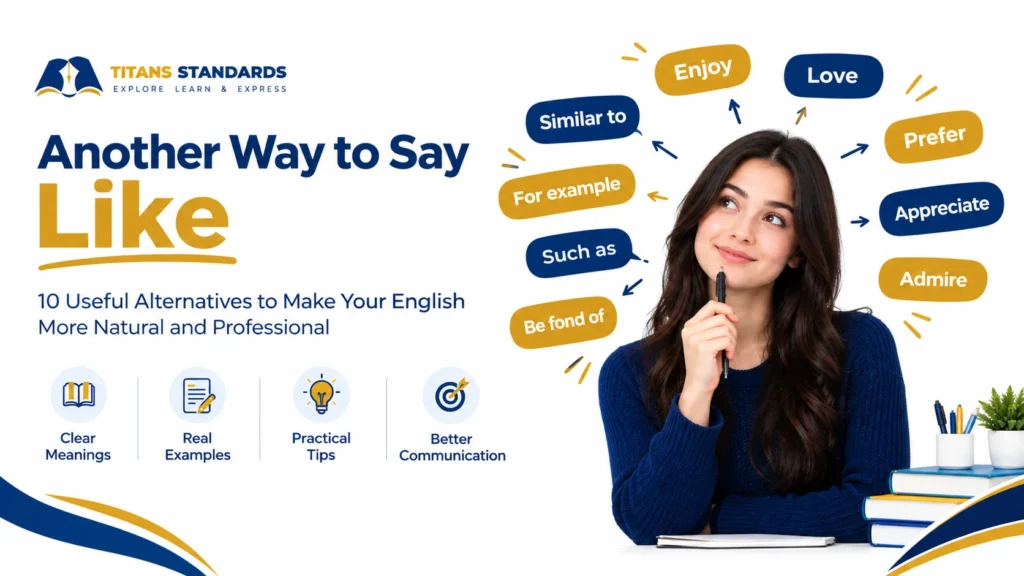
Another way to say “like” depends on the meaning of the sentence. Use enjoy to express pleasure, love for strong feelings, prefer to show a choice, appreciate to recognize value, and admire to express respect. When comparing things, use “similar to.” When giving examples, use “such as” or “for example.” Key Takeaways What Does “Like” Mean? The word “like” has several meanings in American English. It can express enjoyment, show a preference, describe similarities, or introduce examples. For example, “I like reading” expresses enjoyment, while “She looks like her mother” describes a resemblance. In a sentence such as “Outdoor activities like hiking,” the word introduces examples. People use “like” because it is simple, familiar, and flexible. However, choosing a more specific word can make your meaning clearer and your writing more effective. Why Use Other Ways to Say “Like”? Using alternative phrases helps you communicate with greater variety and accuracy. It also allows you to adjust your language to different situations. Consider these benefits: Remember that these alternatives are not always interchangeable. Choose the phrase that matches your intended meaning. 10 Best Other Ways to Say “Like” 1. Enjoy Meaning “Enjoy” means to take pleasure in an activity, experience, or thing. It is one of the most natural alternatives when “like” describes something you find pleasant. Best For Example 1 I enjoy reading mystery novels on the weekends. Example 2 Our team enjoys working together on creative projects. Quick Tip Use “enjoy” when describing activities or experiences, especially in professional bios, personal introductions, and everyday conversations. 2. Love Meaning “Love” expresses a stronger positive feeling than “like.” It works well when you feel enthusiastic about a person, activity, place, or experience. Best For Example 1 I love spending summer evenings at the beach. Example 2 She loves the new coffee shop near her office. Quick Tip Use “love” when you genuinely feel strongly about something. In professional writing, consider whether its emotional tone suits the audience. 3. Prefer Meaning “Prefer” means to favor one option over another. It is especially useful when discussing choices, habits, or personal preferences. Best For Example 1 I prefer morning meetings because I feel more focused. Example 2 Our customers prefer receiving updates by email. Quick Tip When comparing two things, use “prefer A to B” or “prefer doing one thing to doing another.” For example, “I prefer tea to coffee.” 4. Appreciate Meaning “Appreciate” communicates that you recognize the value, quality, or benefit of something. It can sound more thoughtful and professional than simply saying you like something. Best For Example 1 I appreciate the clear instructions you provided. Example 2 We appreciate your patience during the application process. Quick Tip Use “appreciate” to acknowledge help, effort, or a positive quality. It is especially effective in workplace emails and thank-you messages. 5. Admire Meaning “Admire” means to respect someone or value a quality they possess. Unlike “enjoy,” it often communicates appreciation for a person’s character, skills, or achievements. Best For Example 1 I admire how confidently she handles difficult situations. Example 2 The students admire their coach’s dedication and patience. Quick Tip Choose “admire” when respect is the main feeling. It is more suitable than “like” when discussing someone’s courage, honesty, or professional ability. 6. Be Fond Of Meaning “Be fond of” expresses a positive feeling toward a person, activity, or thing. It sounds gentle and personal without expressing the strong emotion associated with “love.” Best For Example 1 My grandfather is fond of old jazz records. Example 2 I’m particularly fond of the small bookstore on Main Street. Quick Tip Use this phrase when you want a warm, conversational alternative. Remember that the verb “be” changes with the subject: “I am fond of” and “she is fond of.” 7. Be Interested In Meaning “Be interested in” expresses curiosity, attention, or a desire to learn more about something. It is useful when “like” suggests that a subject or opportunity appeals to you. Best For Example 1 I’m interested in learning more about your marketing program. Example 2 He is interested in exploring new career opportunities. Quick Tip Use “be interested in” when you want to show curiosity without claiming strong enjoyment. Follow “in” with a noun or an -ing verb, such as “interested in photography.” 8. Similar To Meaning “Similar to” describes two things that share certain qualities but are not necessarily identical. It replaces “like” when the word means “resembling” rather than “enjoying.” Best For Example 1 This laptop is similar to the model I used in college. Example 2 Her teaching style is similar to her mentor’s approach. Quick Tip Use “similar to” in reports, comparisons, and academic writing. Avoid replacing “I like this laptop” with “I am similar to this laptop,” because the meanings are different. 9. Such As Meaning “Such as” introduces specific examples of a broader category. It is useful in informative writing when “like” means “for example” rather than expressing a preference. Best For Example 1 The workshop covers skills such as public speaking and negotiation. Example 2 Many U.S. cities offer outdoor activities such as kayaking and cycling. Quick Tip Use “such as” to introduce examples within a sentence. It is particularly helpful in articles, reports, educational content, and business documents. 10. For Example Meaning “For example” introduces a specific case that helps explain or support a point. Unlike “enjoy” or “prefer,” it does not describe a feeling; it helps readers understand an idea. Best For Example 1 You can improve your writing in several ways. For example, try using shorter sentences. Example 2 Some free tools can help you organize projects. For example, a digital calendar can track deadlines. Quick Tip Use “for example” when you want to make an explanation clearer. It often works well at the beginning of a sentence, followed by a comma. Comparison Table Alternative Best Used In Tone Enjoy Activities and experiences Natural Love Strong positive feelings Warm Prefer Choices and comparisons Clear Appreciate Work emails and gratitude Professional Admire
What is Another Way to Say Rest in Peace

The phrase “rest in peace” expresses sympathy and the hope that someone who has died will find peace. It is commonly shortened to RIP and appears in funeral messages, sympathy cards, obituaries, memorial services, and social media tributes. Key Takeaways What Does “What Is Another Way to Say Rest in Peace” Mean? People use this expression to honor the deceased, acknowledge a loss, and show respect for the grieving family. However, some people prefer different words that sound more personal, comforting, religious, or appropriate for a particular situation. Choosing another way to say “rest in peace” lets you express your feelings in a more meaningful way. Why Use Other Ways to Say “Rest in Peace”? Although “rest in peace” is widely understood, using a different expression can make your message feel more personal and sincere. Consider using an alternative to: The best phrase depends on the occasion, your relationship with the deceased, and the message you want to share. 10 Best Other Ways to Say “Rest in Peace” 1. May They Rest Peacefully Meaning This phrase expresses the hope that someone who has died will be at peace. It is a gentle alternative to “rest in peace” and keeps the same respectful meaning without sounding overly formal. Best For: Formal, Warm, Polite Example 1: May she rest peacefully after a life filled with kindness and love. Example 2: We will always remember his generosity. May he rest peacefully. Quick Tip: Use this phrase in funeral messages, sympathy cards, and respectful memorial tributes. 2. Forever in Our Hearts Meaning This expression honors someone whose memory will continue to live on in the hearts of family and friends. It focuses on love, remembrance, and the lasting impact the person made on others. Best For: Warm, Friendly, Casual Example 1: Grandma, you will be forever in our hearts and never forgotten. Example 2: Though we cannot see him anymore, he will remain forever in our hearts. Quick Tip: This phrase works especially well for social media tributes, memorial photos, and messages about close family members. 3. Gone but Never Forgotten Meaning This phrase recognizes that someone has passed away while emphasizing that their memory will remain alive. It offers comfort by focusing on the person’s lasting influence, cherished moments, and meaningful relationships. Best For: Warm, Casual, Friendly Example 1: Our beloved coach is gone but never forgotten by the players he inspired. Example 2: Gone but never forgotten, Dad. Your lessons still guide us every day. Quick Tip: Choose this expression when you want to celebrate someone’s legacy rather than focus only on their passing. 4. May Their Soul Find Peace Meaning This expression conveys a heartfelt wish for peace after death. It has a spiritual tone and may suit people who believe the soul continues beyond physical life. Best For: Formal, Warm, Polite Example 1: We are deeply saddened by your loss. May your mother’s soul find peace. Example 2: May his soul find peace, and may his family find comfort during this difficult time. Quick Tip: Consider the family’s spiritual beliefs before using language about the soul. 5. Rest Easy Meaning “Rest easy” is a short, gentle expression that communicates peace and farewell. It sounds more conversational than “rest in peace,” making it suitable for personal messages and informal tributes. Best For: Casual, Friendly, Warm Example 1: Rest easy, Uncle Mike. Thank you for all the wonderful memories. Example 2: You fought bravely through so much. Rest easy, my friend. Quick Tip: Use this phrase for a personal tribute when a simple, sincere message feels more natural than formal wording. 6. May They Rest in Eternal Peace Meaning This phrase expresses a wish for lasting peace after death. The word “eternal” adds a solemn, timeless quality, making it suitable for formal memorials and traditional funeral messages. Best For: Formal, Professional, Polite Example 1: May she rest in eternal peace, remembered for her compassion and courage. Example 2: We honor his years of service and pray that he rests in eternal peace. Quick Tip: This expression is more formal than “rest easy,” so use it when the occasion calls for a dignified tone. 7. May Their Memory Be a Blessing Meaning This expression honors the positive influence of someone who has died and wishes that their memory brings comfort and goodness to others. It is associated with Jewish mourning traditions but can also be used in appropriate contexts beyond them. Best For: Formal, Warm, Polite Example 1: She devoted her life to helping others. May her memory be a blessing to everyone she touched. Example 2: We are grateful for the kindness he shared with our community. May his memory be a blessing. Quick Tip: Use this phrase thoughtfully, especially when you know it aligns with the family’s traditions or beliefs. 8. At Peace Now Meaning “At peace now” suggests that a person is no longer experiencing pain or hardship. People often use it when someone has faced a long illness or a difficult period, although the wording may not fit every loss. Best For: Casual, Warm, Polite Example 1: After a long and difficult illness, we hope she is at peace now. Example 2: He endured so much with courage. May his loved ones find comfort knowing he is at peace now. Quick Tip: Use this phrase with care. Avoid assuming that the death was peaceful or that grieving family members share your interpretation. 9. May They Rest in Heaven Meaning This phrase expresses the hope that someone who has died is resting peacefully in heaven. It reflects a belief in an afterlife and is most appropriate when that belief fits the deceased or their family’s faith. Best For: Warm, Formal, Polite Example 1: May your father rest in heaven, surrounded by everlasting peace. Example 2: She brought so much joy into our lives. May she rest in heaven. Quick Tip: If you are unsure about someone’s religious beliefs, choose a nonreligious phrase such as “forever in our hearts.” 10.
Another Way to Say In Summary: 10 Natural Alternatives
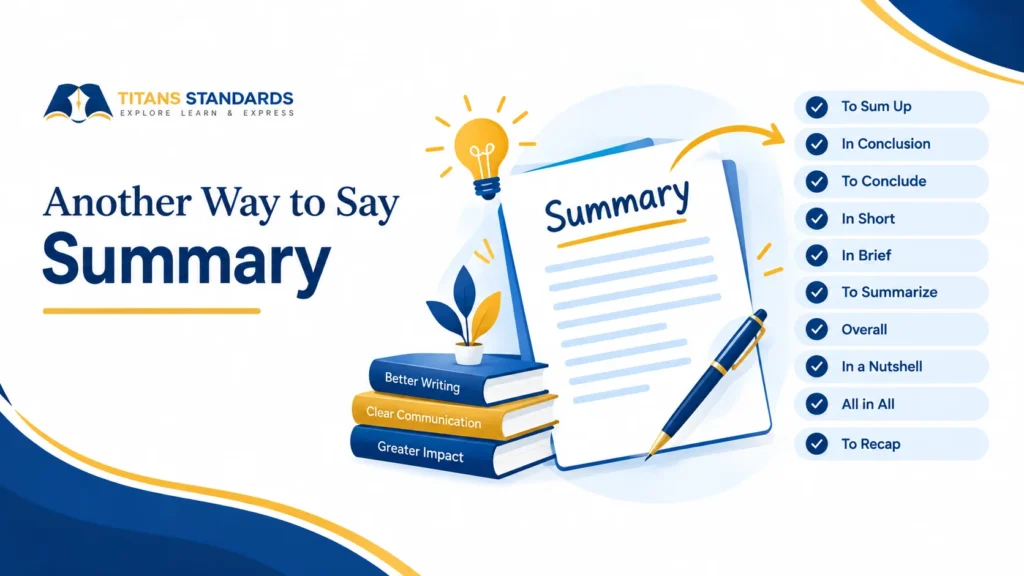
If you want another way to say “in summary,” you can use phrases such as “to sum up,” “in conclusion,” “in short,” “in brief,” “to summarize,” and “overall.” The best choice depends on your context, tone, and whether you are writing an essay, email, report, presentation, or casual message. What Does “Another Way to Say In Summary” Mean? “In summary” is a transition phrase used to introduce the main points or final idea of something that has already been discussed. It signals to the reader or listener that you are about to give a short version of the most important information. For example: “In summary, the project was completed on time and stayed within budget.” People often look for other ways to say “in summary” because repeating the same transition can make writing feel predictable. Using a suitable alternative can make your writing smoother, clearer, and better matched to the situation. You commonly see these phrases in essays, reports, business communication, presentations, articles, emails, and everyday conversations. Why Use Other Ways to Say “In Summary”? Using different concluding phrases can make your communication more natural and precise. The key is not simply to find a synonym. Choose the phrase that communicates the right level of formality and meaning. 10 Best Other Ways to Say “In Summary” 1. To Sum Up Meaning “To sum up” introduces a brief statement of the main points that were just discussed. It is natural, clear, and slightly less formal than “in summary.” Best For Example 1 To sum up, we need more time to test the new system before launch. Example 2 To sum up, the trip was affordable, comfortable, and easy to organize. Quick Tip Use “to sum up” when you want a natural transition that works well in both speech and writing. 2. In Conclusion Meaning “In conclusion” introduces the final thoughts or judgment after discussing several points. It is especially common in essays, reports, academic writing, and formal presentations. Best For Example 1 In conclusion, the research shows that regular exercise can improve overall well-being. Example 2 In conclusion, the proposal offers a practical solution to the current staffing problem. Quick Tip Use “in conclusion” when you are ending a structured piece of writing rather than simply giving a quick recap. 3. To Conclude Meaning “To conclude” serves a similar purpose to “in conclusion” and signals that you are presenting your final thoughts. It has a formal and polished tone. Best For Example 1 To conclude, both options have advantages, but the second plan is more affordable. Example 2 To conclude, our findings support the need for additional training. Quick Tip “To conclude” works particularly well at the beginning of the final paragraph of a formal document. 4. In Short Meaning “In short” means “in a few words” or “to state the main point briefly.” It is useful when you want to reduce a longer explanation to its most important idea. Best For Example 1 In short, the new policy gives employees more flexibility. Example 2 In short, we spent less money and achieved better results. Quick Tip Choose “in short” when brevity is the main goal rather than a formal conclusion. 5. In Brief Meaning “In brief” introduces a shortened version of information. It is concise and slightly more formal than “in short,” making it useful in professional and written communication. Best For Example 1 In brief, the company plans to expand its services next year. Example 2 In brief, the agreement protects both parties from unexpected costs. Quick Tip Use “in brief” when summarizing information in reports, business communication, or other concise written formats. 6. To Summarize Meaning “To summarize” directly tells the reader that you are about to restate the main points. It is clear and straightforward without sounding overly formal. Best For Example 1 To summarize, the team met all three major project goals. Example 2 To summarize, customers want faster delivery and simpler payment options. Quick Tip Use “to summarize” when clarity matters more than stylistic variety. 7. Overall Meaning “Overall” gives a general judgment or broad view after considering several details. Unlike “in summary,” it does not always introduce a complete recap. Best For Example 1 Overall, the conference was well organized and informative. Example 2 Overall, sales improved despite a difficult start to the quarter. Quick Tip Use “overall” when you want to give a general assessment rather than repeat every major point. 8. In a Nutshell Meaning “In a nutshell” means “in a very brief form.” It has a conversational tone and is useful when explaining a complicated idea in simple terms. Best For Example 1 In a nutshell, the new software saves time and reduces errors. Example 2 In a nutshell, we need a better plan before we move forward. Quick Tip Avoid “in a nutshell” in highly formal academic or corporate writing because it can sound too conversational. 9. All in All Meaning “All in all” gives an overall judgment after considering different aspects of a situation. It often sounds natural and conversational. Best For Example 1 All in all, the weekend was relaxing and enjoyable. Example 2 All in all, the changes have made the process much easier. Quick Tip Use “all in all” when giving a broad opinion, especially in conversational or personal writing. 10. To Recap Meaning “To recap” means to briefly review the important information that has already been covered. It is especially useful in meetings, presentations, lessons, and conversations. Best For Example 1 To recap, the meeting starts at 9 a.m., and everyone should bring the updated reports. Example 2 To recap, we chose the cheaper option because it offered better long-term value. Quick Tip Use “to recap” when you are reviewing previously discussed information rather than presenting a final conclusion. Comparison Table Alternative Best Used In Tone To Sum Up General writing and speech Natural In Conclusion Essays and formal writing Formal To Conclude Reports and formal writing Formal In Short Everyday communication Concise In
Another Way to Say Additionally: 10 Natural Alternatives
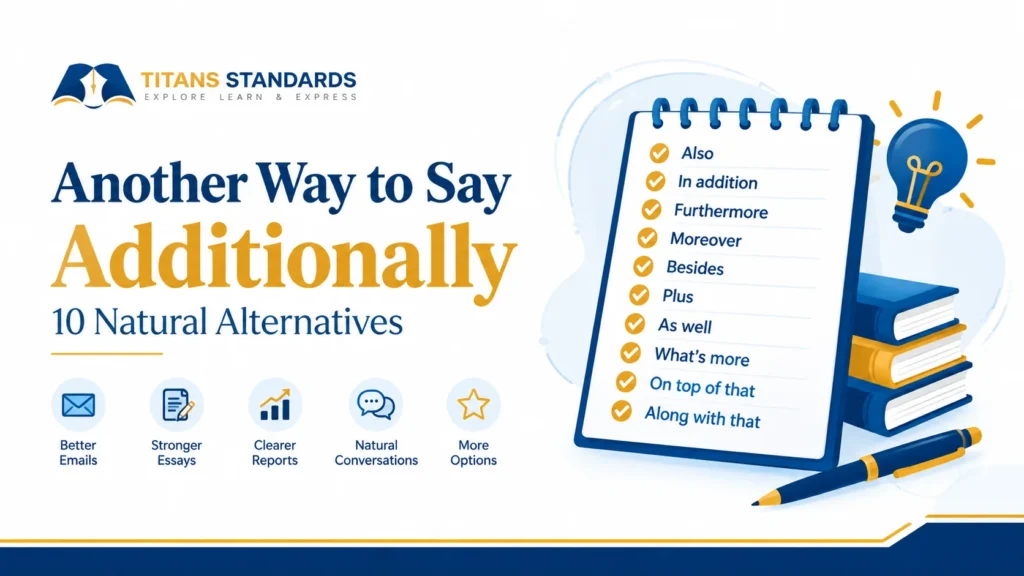
Looking for another way to say additionally? Learn 10 natural alternatives for formal, professional, academic, and everyday English.
Another Way to Say Person: 10 Natural Alternatives

Looking for another way to say person? The best alternative depends on your meaning and context. Common choices include individual, human being, someone, somebody, adult, citizen, and character. Some sound more formal, while others work better in casual conversation or specific situations. Key Takeaways What Does “Another Way to Say Person” Mean? “Another way to say person” means looking for a different word or phrase that refers to a human individual. People often search for alternatives to avoid repetition, make writing more precise, or choose language that better matches a particular situation. For example, individual can sound more professional than “person,” while someone sounds natural in everyday conversation. Why Use Other Ways to Say “Person”? Using alternatives can make your writing clearer and more natural. The best choice depends on what you are describing and how formal you want to sound. 10 Best Other Ways to Say “Person” 1. Individual Meaning Individual refers to one particular person. It is a useful replacement for “person” when you want your writing to sound neutral, precise, or professional. Best For Example 1 Each individual is responsible for completing the registration form. Example 2 The program gives every individual an opportunity to develop new skills. Quick Tip Use individual in professional, academic, and official writing when “person” feels too general. 2. Human Being Meaning Human being emphasizes that someone is a member of the human species. It often appears when discussing human nature, behavior, emotions, or basic human experiences. Best For Example 1 Every human being deserves to be treated with respect. Example 2 As a human being, she understood how difficult the situation was. Quick Tip Choose human being when you want to emphasize humanity rather than someone’s role or identity. 3. Someone Meaning Someone means an unspecified person. It is one of the most natural alternatives to “person” in everyday American English. Best For Example 1 Someone left a jacket on the chair. Example 2 If someone needs help, they can contact the front desk. Quick Tip Use someone when you are talking about an unknown or unspecified person. 4. Somebody Meaning Somebody also means an unspecified person and is very common in casual conversation. It usually has the same basic meaning as “someone.” Best For Example 1 Somebody called while you were away. Example 2 I think somebody forgot to close the window. Quick Tip Somebody is slightly more conversational, while someone can fit both casual and neutral writing. 5. Human Meaning Human can refer to a person when the focus is on humanity, behavior, or human characteristics. It is often used as a noun in specific contexts rather than as a direct replacement in every sentence. Best For Example 1 Every human makes mistakes from time to time. Example 2 The story explores what it means to be human. Quick Tip Use human when the sentence focuses on human nature or characteristics, not simply as a replacement for “person.” 6. Adult Meaning Adult specifically refers to a grown person rather than a child. It is a more precise choice when age matters in the sentence. Best For Example 1 Each adult must show identification before entering the event. Example 2 The course is designed for adults who want to improve their writing. Quick Tip Do not use adult as a general synonym for “person” if the person’s age is unknown or irrelevant. 7. Citizen Meaning Citizen refers to a person who legally belongs to a particular country. It can also describe someone as a member of a community in certain contexts. Best For Example 1 Every citizen has certain rights and responsibilities. Example 2 The new policy affects citizens across the state. Quick Tip Use citizen only when nationality, legal status, or civic membership is relevant. 8. Character Meaning Character can refer to a person, especially in a story, play, movie, or fictional setting. It can also describe someone’s personality, so context is important. Best For Example 1 The main character changes significantly throughout the novel. Example 2 The film introduces several memorable characters. Quick Tip Use character for people in stories or fictional works rather than as a universal replacement for “person.” 9. Party Meaning Party can mean a person involved in an agreement, legal matter, transaction, or dispute. It is common in business and legal language. Best For Example 1 Both parties agreed to the terms of the contract. Example 2 The injured party may be entitled to compensation. Quick Tip Use party when someone is participating in a formal agreement, case, transaction, or proceeding. 10. Fellow Meaning Fellow can refer to a person, often with a friendly or informal tone. It commonly appears before a noun, such as “fellow employee,” “fellow traveler,” or “fellow student.” Best For Example 1 A fellow traveler helped me find the correct platform. Example 2 She asked a fellow student for advice about the assignment. Quick Tip Fellow works best when you are describing someone who shares an activity, group, experience, or situation with you. Comparison Table Alternative Best Used In Tone Individual Professional writing Formal, neutral Human being General or philosophical contexts Warm, neutral Someone Everyday conversation Natural, neutral Somebody Casual conversation Casual Human Human nature and behavior Neutral Adult Age-specific contexts Neutral Citizen Civic or legal contexts Formal Character Stories and fictional works Neutral Party Legal and business contexts Formal Fellow Shared experiences or groups Friendly Common Mistakes 1. Using a context-specific word everywhere Words such as citizen, adult, character, and party have specific meanings. They should not automatically replace “person” in every sentence. 2. Making professional writing too casual Words like somebody can sound conversational. In formal documents, individual may be a better choice. 3. Using “human” when you simply mean “person” “Human” often focuses on humanity or human characteristics. If you only mean one particular person, individual may be clearer. 4. Ignoring age Adult specifically means a grown person. Avoid using it when you do not know whether the person is an adult. 5. Choosing a synonym
Another Way to Say Happy Birthday: 12 Natural Wishes

If you want another way to say “Happy Birthday,” the best choice depends on who you’re talking to and how you want the message to feel. Try “Wishing you a wonderful birthday” for a warm, versatile option, “Cheers to another year” for something casual, or “Warmest birthday wishes” for a more polished message. For close relationships, you can make the wording more personal and affectionate. Key Takeaways What Does “Happy Birthday” Mean? “Happy Birthday” is a standard greeting used to wish someone happiness on the anniversary of their birth. It can be said in person, written in a card, sent by text, added to an email, or posted on social media. The phrase is already natural and appropriate in most situations. You do not need to replace it just because it is common. However, another wording can help when you want your message to sound warmer, more personal, more professional, or simply less repetitive. For example: Happy Birthday! I hope you have a great day. could become: Wishing you a wonderful birthday and a year filled with good things. The second version puts more attention on the person and the year ahead. Why Use Another Way to Say “Happy Birthday”? Sometimes the basic phrase does not quite match the message you want to send. You may want to: The goal is not to find a “better” synonym. It is to choose wording that fits the relationship and occasion. 12 Best Ways to Say “Happy Birthday” 1. Wishing You a Wonderful Birthday This is one of the most versatile alternatives. It keeps the meaning of “Happy Birthday” while sounding slightly more thoughtful and complete. Use it for friends, relatives, coworkers, acquaintances, or someone you do not know extremely well. Example: Wishing you a wonderful birthday and a year full of exciting opportunities. 2. Have a Fantastic Birthday “Fantastic” adds energy and enthusiasm without making the message overly emotional. It works especially well in casual texts, cards, and friendly conversations. Example: Have a fantastic birthday! I hope you get to spend the day doing exactly what you enjoy. 3. Hope You Have an Amazing Day This sounds natural in everyday American English because it focuses on the person’s actual birthday experience rather than simply naming the occasion. It is a good choice for texts, quick messages, and casual conversations. Example: Hope you have an amazing day and get plenty of time to celebrate. 4. Wishing You All the Best This is useful when you want your birthday message to feel kind and polished without becoming overly personal. It can work especially well for coworkers, acquaintances, teachers, or professional contacts. It also works nicely when followed by a specific birthday wish. Example: Wishing you all the best on your birthday and in the year ahead. 5. Enjoy Your Special Day “Enjoy your special day” is simple, friendly, and easy to use. It does not sound as formal as some traditional birthday greetings, but it is still polite. It fits cards, texts, workplace chats, and everyday conversations. Example: Enjoy your special day, and I hope you get to celebrate with the people you love. 6. Warmest Birthday Wishes This phrase gives a birthday message a more polished and heartfelt tone. “Warmest” adds friendliness without making the greeting too intimate. It works particularly well in cards and written messages where you want to sound thoughtful. Example: Warmest birthday wishes to you. May the coming year bring you plenty of happiness. 7. Cheers to Another Year This is a more casual and celebratory option. Instead of focusing only on the birthday itself, it celebrates another year of the person’s life. It is a natural choice for friends, siblings, social media captions, and informal cards. Example: Cheers to another year! Here’s hoping this one brings you new adventures and great memories. 8. May Your Year Ahead Be Filled With Happiness This alternative shifts the focus from the birthday itself to the year that follows. It sounds sincere and works well when you want a more meaningful message. It is especially suitable for cards or messages to someone important to you. Example: May your year ahead be filled with happiness, good health, and plenty of reasons to smile. 9. Many Happy Returns “Many happy returns” is a traditional birthday expression that wishes someone many more happy birthdays. It is recognizable, but it has a more traditional feel than everyday “Happy Birthday” in American English. Choose it when a classic or slightly formal tone suits the recipient. Example: Many happy returns! I hope you have a wonderful birthday and a great year ahead. 10. Celebrating You Today This phrase puts the focus directly on the person rather than the birthday greeting itself. It can sound especially warm in a social media post, card, or personal message. Example: Celebrating you today and all the kindness and laughter you bring to the people around you. 11. Sending Birthday Love This is an affectionate option for people you are close to. It sounds much more personal than a standard workplace greeting, so it should be reserved for appropriate relationships. Example: Sending birthday love your way. I hope your day is full of laughter, good food, and your favorite people. 12. Hope Today Feels Extra Special This is a gentle, natural alternative when you want to make the message feel personal without using a very emotional expression. It works well for friends, relatives, and other people you care about. Example: Hope today feels extra special because you deserve a wonderful year ahead. Which Alternative Fits Your Situation? The relationship matters as much as the wording. Alternative Best Used In Tone Wishing You a Wonderful Birthday Most situations Warm, neutral Have a Fantastic Birthday Friends and casual messages Cheerful Hope You Have an Amazing Day Texts and everyday conversation Casual, friendly Wishing You All the Best Coworkers and acquaintances Polite, warm Enjoy Your Special Day Cards, texts, workplace chats Friendly, neutral Warmest Birthday Wishes Cards and written greetings Warm, polished Cheers to Another
What’s Another Way to Say Thank You? 12 Natural Alternatives

“Thank you” is one of the most useful expressions in English, but you do not have to use the same phrase every time. The best alternative depends on who you are speaking to, what they did, and how strongly you want to express your appreciation. For a friend, “Thanks!” may be enough. For a coworker, “I really appreciate your help” sounds specific and professional. If someone gave you meaningful emotional support, “That means a lot to me” may express more than a simple thank-you. Quick Answer Another way to say thank you depends on the situation and how much appreciation you want to express. Natural options include thanks, I really appreciate it, I’m grateful, that means a lot, that’s very kind of you, much appreciated, and I can’t thank you enough. Choose a phrase that matches your relationship, tone, and level of gratitude. Key Takeaways What Does “Thank You” Mean? Thank you is a polite expression used to show gratitude or appreciation for something someone has done, given, or said. It can be used in almost any setting: Because thank you is neutral and widely accepted, it is rarely wrong. The main reason to choose another expression is not that “thank you” is incorrect. It is to make your response more specific, personal, casual, warm, or formal. Why Use Another Way to Say Thank You? Different expressions can help you: The important point is not to replace “thank you” just for variety. Choose another phrase when it communicates your meaning more precisely. 12 Best Ways to Say Thank You 1. Thanks Thanks is the simplest and most common casual alternative to thank you. It works well with friends, family, coworkers you know well, and in quick everyday exchanges. “Thanks for picking me up at the airport.” It is shorter and more relaxed than “thank you,” but it still clearly expresses appreciation. 2. Thanks so much Use thanks so much when you want to sound warmer or more appreciative than a simple “thanks.” “Thanks so much for helping me move this weekend.” It fits texts, conversations, cards, and friendly messages. It can also work in professional communication when the relationship is reasonably friendly. 3. I really appreciate it I really appreciate it is one of the most flexible alternatives. It works when someone has done something helpful, thoughtful, or generous. “You stayed late to help me finish the report. I really appreciate it.” This phrase is especially useful when you want your gratitude to sound sincere without becoming overly formal. 4. I appreciate your help When you want to identify exactly what you are grateful for, I appreciate your help is a strong choice. “I appreciate your help with the presentation.” This is particularly natural in workplace communication because it recognizes the person’s assistance directly. It can also be used with friends or family. 5. I’m grateful I’m grateful expresses more personal or meaningful appreciation than a quick “thanks.” “I’m grateful for everything you did to support me.” It works especially well when someone has offered significant help, support, kindness, or encouragement. For a small everyday favor, however, it may sound more serious than necessary. 6. That means a lot to me Use that means a lot to me when the person’s action has emotional or personal importance. “You remembered my birthday. That means a lot to me.” This is warmer and more personal than a routine “thank you,” making it useful for close friends, family members, partners, or someone who offered meaningful support. 7. That’s very kind of you That’s very kind of you acknowledges not only what someone did but also the kindness behind the action. “You brought dinner for everyone? That’s very kind of you.” It can be used in both personal and polite everyday situations. It is especially natural after a thoughtful gesture. 8. Much appreciated Much appreciated is a concise way to show appreciation, particularly in informal or professional communication. “Thanks for sending the updated file. Much appreciated.” It is efficient and friendly, but it can sound less personal than I really appreciate it. It works well when you want to keep a message brief. 9. I owe you one I owe you one is an informal expression that suggests you will return the favor later. “Thanks for covering my shift. I owe you one!” This is best for friends or familiar coworkers. It is not a direct substitute for every “thank you,” because it adds the idea of future repayment or reciprocity. 10. I can’t thank you enough Use I can’t thank you enough when someone has helped you so much that a normal expression of thanks feels insufficient. “I can’t thank you enough for helping my family through this.” This phrase communicates strong gratitude. It is better suited to meaningful favors or major support than to small everyday actions. 11. Many thanks Many thanks is a polite, concise expression often used in writing. “Many thanks for your quick response.” It can work in emails, notes, and other written communication. It sounds more polished than “thanks,” while remaining less formal than highly ceremonial expressions of gratitude. 12. Thank you so much Although it still contains the original phrase, thank you so much deserves a place among useful alternatives because it changes the strength and warmth of the expression. “Thank you so much for making time to meet with me.” It works across many situations, from personal conversations to professional messages. The added so much makes the appreciation more emphatic without requiring an entirely different expression. Which Thank-You Phrase Should You Choose? Alternative Best Used In Tone Thanks Quick everyday exchanges Casual Thanks so much Friendly conversations and messages Warm, casual I really appreciate it Help, favors, and support Warm, neutral I appreciate your help Workplace or specific assistance Professional, polite I’m grateful Meaningful support or kindness Sincere That means a lot to me Personal or emotional situations Warm, heartfelt That’s very kind of you Thoughtful gestures Warm, polite Much appreciated Short messages and workplace
Another Way to Say During: 12 Natural Alternatives
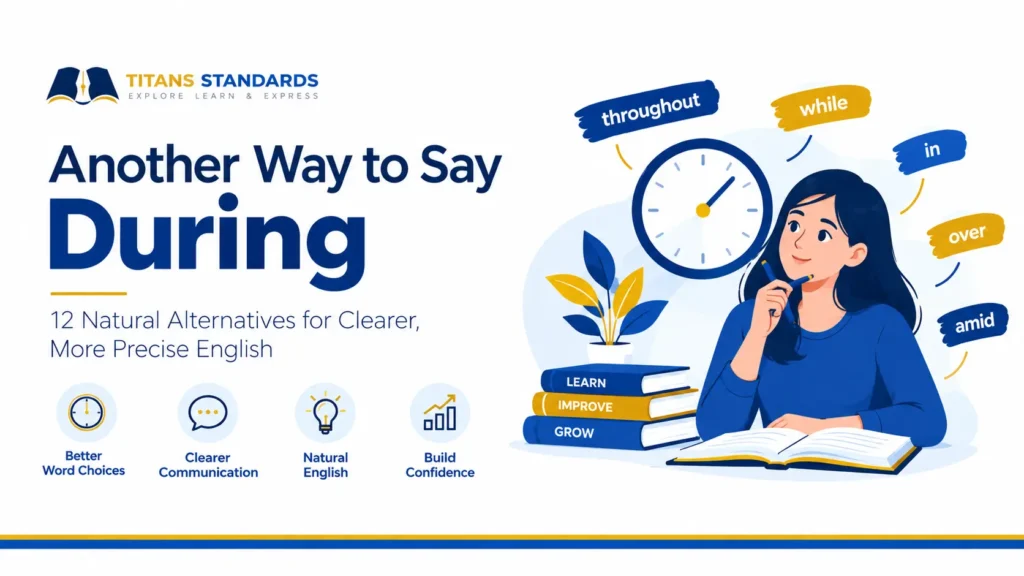
If you need another way to say “during,” the best replacement depends on what you mean. Use throughout when something continues across an entire period, while when two actions happen at the same time, in for broad time periods, and amid for a situation or surrounding condition. Other options include over, through, throughout the course of, in the course of, for the duration of, at the time of, and as. Key Takeaways What Does “During” Mean? “During” is a preposition used to say when something happens within a particular period or event. It can describe something that happens throughout an event or something that occurs at an unspecified point within it. For example, “We talked during the meeting” means the conversation happened at some point within the meeting. A key grammar point is that during normally comes before a noun or noun phrase: You generally cannot put a complete clause directly after “during.” For example, “during I was studying” is incorrect; “while I was studying” is the natural construction. Why Use Another Way to Say “During”? “During” is already natural and useful, so there is no need to replace it simply for the sake of variety. An alternative helps when you want to make the meaning more precise. You may want a different expression to: The important point is that a synonym should match the intended meaning, not just resemble “during” in a thesaurus. 12 Best Ways to Say “During” 1. Throughout Throughout is one of the closest alternatives when you mean that something happened across the entire period. Unlike “during,” it often emphasizes continuity from one part of the period to another. The second sentence more strongly suggests that her calmness continued across the meeting. Best for: entire periods, events, or spans of time. 2. While Use while when you are connecting two actions or events that happen at the same time. The grammar is different: “while” normally introduces a clause containing a subject and verb. This makes “while” especially useful when you want to describe simultaneous actions. Best for: actions happening at the same time. 3. In “In” can replace “during” with many broad periods, especially months, years, seasons, and historical periods. It can also work with periods such as “the 1990s,” “the afternoon,” and “the winter.” Best for: broad time periods and dates. 4. Over Over works well when something happens across a period of time. It can suggest repeated activity, change, or development rather than a single moment. It is particularly natural in everyday and professional writing when discussing trends. Best for: periods involving change, progress, or repeated events. 5. Through Through can emphasize continuation across a period, although it does not fit every sentence where “during” appears. It often sounds more active and can suggest movement from one part of a period toward another. Best for: continuous activity across a period. 6. Amid Amid means in the middle of or surrounded by a situation, condition, or event. It is useful when the surrounding circumstances matter as much as the timing. “Amid” is not a direct substitute for every time expression. It works best when the noun describes a surrounding situation. Best for: confusion, uncertainty, change, conflict, excitement, or other circumstances. 7. Amidst Amidst has essentially the same core meaning as “amid,” but it tends to sound more literary or formal. In American English, amid is usually the simpler choice. Use it when its style fits the writing rather than treating it as a universal replacement. Best for: formal or literary contexts. 8. In the Course of In the course of refers to something that happens as part of a period, activity, or process. It is especially useful in formal, professional, and academic writing. The longer phrase can sound more deliberate and formal than the simple “during.” Best for: investigations, projects, processes, professional writing, and formal explanations. 9. Over the Course of Over the course of emphasizes development across a period rather than simply placing an event inside it. It is particularly natural when discussing changes that happen gradually. Best for: gradual change, progress, development, and longer periods. 10. For the Duration of For the duration of explicitly emphasizes the full length of an event or period. This phrase is more formal and can sound official, so it is often better suited to policies, instructions, notices, or formal documents. Best for: formal rules, policies, instructions, and complete durations. 11. At the Time of At the time of points to the period or circumstances surrounding a particular event. It can be useful when “during” feels too broad. The meaning is not always identical. “At the time of” often focuses on the circumstances existing when a particular event occurred. Best for: specific events, dates, transitions, and historical references. 12. As As can describe two events happening at the same time, especially when one action develops alongside another. It is often a smoother choice when you want to connect two clauses rather than place a noun after a preposition. Cambridge notes that “as,” “when,” and “while” can all introduce subordinate clauses describing simultaneous events, with differences in emphasis and context. Best for: simultaneous actions or events in connected clauses. During vs. Its Closest Alternatives Alternative Best Used In Tone Throughout The entire period Neutral While Two simultaneous actions Neutral In Broad time periods Neutral Over Change across a period Neutral Through Continued activity Neutral Amid Surrounding situations Neutral/Formal Amidst Situations or surroundings Formal/Literary In the course of Processes and formal contexts Formal Over the course of Gradual development Neutral/Formal For the duration of Full duration, rules, policies Formal At the time of A particular event or point Neutral/Formal As Simultaneous clauses Neutral During vs. Throughout vs. While These three are easy to confuse because they can describe overlapping time relationships. During places something within a period: We received several calls during the afternoon. Throughout emphasizes the whole period: We received calls throughout the afternoon. While connects simultaneous actions: We received calls while we were working. The grammar also
Another Way to Say You’re Welcome in Spanish: 10 Natural Ways

If someone says “gracias” in Spanish, the standard response is de nada, meaning “you’re welcome.” But Spanish offers several other natural replies depending on the situation, country, and tone. You can use con gusto for a warm response, no hay de qué for a polite “don’t mention it,” or a ti / a usted when you want to return the thanks. What Does “You’re Welcome” Mean in Spanish? When English speakers say “you’re welcome” after someone says “thank you,” they are usually acknowledging the thanks and signaling that the favor was willingly given. In Spanish, the most common equivalent is: De nada — “You’re welcome” / “It was nothing.” For example: —Gracias por tu ayuda.—De nada. —Thanks for your help.—You’re welcome. The important point is that “you’re welcome” in this situation is an idiomatic expression. It should not normally be translated word for word as eres bienvenido. Spanish uses different expressions to respond to gracias. 10 Ways to Say “You’re Welcome” in Spanish 1. De nada — You’re welcome De nada is the standard, neutral way to respond to gracias. It works in everyday conversations and is understood throughout the Spanish-speaking world. —Muchas gracias por el consejo.—De nada. “Thank you very much for the advice.”“You’re welcome.” If you are unsure which expression to use, de nada is the safest choice. 2. No hay de qué — Don’t mention it No hay de qué literally suggests that there is nothing to thank someone for. In natural English, it is close to “don’t mention it” or “you’re welcome.” It can sound especially polite when someone gives you a sincere thank-you. —Muchas gracias por tomarte el tiempo de ayudarme.—No hay de qué. “Thanks so much for taking the time to help me.”“Don’t mention it.” This expression is useful when you want something a little more expressive than the simple de nada. 3. Con gusto — With pleasure Con gusto means “with pleasure” or “gladly.” It presents the help as something you were happy to provide. —Gracias por explicarme cómo funciona.—Con gusto. “Thanks for explaining how it works.”“With pleasure.” You may hear con gusto often in friendly, polite, or service-related situations, particularly in Latin America. 4. Por nada — No problem / You’re welcome Por nada is another expression that can be used in response to gracias. It is similar to de nada and can sound casual. —Gracias por guardar mi asiento.—Por nada. “Thanks for saving my seat.”“No problem.” It is useful to recognize, but de nada remains the more universal default for learners. 5. A ti — Thank you / You’re welcome A ti literally means “to you.” It is commonly used when the speaker feels that the other person deserves some of the thanks. For example: —Gracias por venir conmigo.—A ti. “Thanks for coming with me.”“Thank you.” This expression is informal because ti is associated with the familiar tú form. 6. A usted — Thank you / You’re welcome A usted works similarly to a ti, but it uses the formal usted form. —Muchas gracias por su ayuda.—A usted. “Thank you very much for your help.”“Thank you.” The exact English translation depends on the situation. Rather than functioning as a direct equivalent of you’re welcome in every context, a usted can acknowledge that the thanks are mutual or that the other person is also deserving of appreciation. 7. Es un placer — It’s a pleasure Es un placer means “it’s a pleasure.” It emphasizes that you were pleased to help. —Muchas gracias por recibirnos.—Es un placer. “Thank you very much for having us.”“It’s a pleasure.” This works especially well when you want your response to sound warm and courteous rather than brief. 8. No hay problema — No problem No hay problema literally means “there’s no problem.” It can be used as a relaxed response to thanks. —Gracias por llevarme a casa.—No hay problema. “Thanks for driving me home.”“No problem.” It is a good fit for casual conversations, although it shifts the focus slightly from gratitude to reassurance that the favor caused no inconvenience. 9. A la orden — At your service A la orden can convey the idea of “at your service” or “anytime.” It is particularly associated with service and hospitality in parts of Latin America. —Muchas gracias por su ayuda.—A la orden. “Thank you very much for your help.”“At your service.” This is a good expression to recognize if you are traveling or interacting with Spanish speakers in different Latin American regions. It is more regionally marked than de nada. 10. Cuando quieras — Anytime Cuando quieras means “whenever you want” or, more naturally in some contexts, “anytime.” —Gracias por ayudarme con el proyecto.—Cuando quieras. “Thanks for helping me with the project.”“Anytime.” It is especially natural when you want to suggest that you would be happy to help again. Which Spanish Expression Should You Use? The best expression depends on how you want to sound. Alternative Best Used In Tone De nada General situations Neutral No hay de qué Polite conversations Polite Con gusto Friendly or service situations Warm Por nada Casual conversations Casual A ti Informal exchanges Friendly A usted Formal or respectful exchanges Polite Es un placer Courteous situations Warm / formal No hay problema Everyday conversations Relaxed A la orden Service and regional contexts Courteous Cuando quieras Friends and familiar situations Friendly “De Nada” vs. “Con Gusto” vs. “No Hay de Qué” These three are easy to confuse because all can respond to gracias, but they do not create exactly the same impression. De nada is the neutral default. Use it when you simply want to say “you’re welcome.” Con gusto emphasizes willingness: you were happy to help. No hay de qué emphasizes that the favor was not something the other person needs to worry about thanking you for. Compare: —Gracias por tu ayuda.—De nada. Simple and neutral. —Gracias por tu ayuda.—Con gusto. Warm and willing. —Muchas gracias por tu ayuda.—No hay de qué. Polite and reassuring. Common Mistakes to Avoid 1. Using “bienvenido” as
Another Way to Say Motivated: 12 Natural Alternatives

Another way to say motivated includes driven, determined, committed, dedicated, ambitious, focused, enthusiastic, eager, proactive, inspired, goal-oriented, and passionate. The best choice depends on what you mean. Use driven for strong goal focus, enthusiastic for excitement, committed for dedication, and proactive when someone takes initiative. Key Takeaways What Does “Motivated” Mean? “Motivated” describes someone who has a strong reason, desire, or willingness to do something. It can refer to a person’s attitude, effort, ambition, or emotional drive. For example: She is motivated to improve her writing skills. Here, motivated means she has the desire and determination to improve. The word can also describe someone at work: He is a motivated employee who consistently works toward his goals. Depending on the situation, however, “motivated” can be too broad. It does not tell the reader exactly why someone is motivated or how that motivation appears. That is why words such as driven, determined, committed, or proactive can sometimes communicate the idea more precisely. Why Use Another Way to Say Motivated? Replacing “motivated” is useful when you want to make your writing more specific. For example, compare: She is motivated at work. with: She is committed to improving the customer experience. The second sentence gives the reader more information. You may want another word for “motivated” to: The key is not to replace “motivated” automatically. Choose a word that describes the specific quality you want to communicate. 12 Best Ways to Say “Motivated” 1. Driven Driven is one of the closest alternatives when someone has a strong desire to reach a goal. It works particularly well in professional and career contexts. She is driven to build a successful career in marketing. Use driven when the person’s motivation is closely connected to achievement, progress, or results. 2. Determined Determined emphasizes the decision to keep pursuing something despite difficulty. It is stronger than simply saying someone is interested or willing. He was determined to finish the project before the deadline. Choose determined when persistence is the important part of the person’s motivation. 3. Committed Committed focuses on dedication to a goal, responsibility, person, or cause. It often sounds more measured and professional than driven. She is committed to providing reliable service to every customer. This is particularly useful in workplace communication, performance reviews, interviews, and professional profiles. 4. Dedicated Dedicated describes someone who consistently gives time, effort, or attention to something important. The team is dedicated to improving the quality of its work. While motivated can describe a current state of enthusiasm, dedicated often suggests sustained effort and reliability. 5. Ambitious Ambitious works when motivation is connected to achieving significant goals or advancing professionally. Marcus is ambitious and hopes to lead a larger team within the next few years. It is not always interchangeable with motivated. Someone can be highly motivated without wanting a promotion or major achievement, so use ambitious when strong aspirations are part of the meaning. 6. Focused Focused highlights concentration on a particular objective rather than motivation itself. She is focused on completing the training program this month. This word is useful when you want to show that someone’s motivation has turned into clear attention and effort. 7. Enthusiastic Enthusiastic emphasizes excitement, interest, or positive energy. He is enthusiastic about joining the new project. Use it when the emotional side of motivation matters. Someone can be enthusiastic without necessarily being highly determined, so it is not a perfect substitute in every sentence. 8. Eager Eager means strongly interested or ready to do something. It often sounds more immediate than motivated. The new employees were eager to learn the company’s procedures. This is a natural choice when someone is looking forward to an opportunity or is ready to take action. 9. Proactive Proactive describes someone who takes action without waiting for instructions or problems to appear. She is proactive about finding ways to improve the team’s workflow. This is especially useful in professional writing because it describes behavior, not just an internal feeling of motivation. 10. Inspired Inspired suggests that someone has gained motivation, creativity, or enthusiasm from an idea, person, experience, or goal. The speaker left the audience inspired to make a change. Use inspired when you want to identify motivation as something sparked by a particular influence. 11. Goal-Oriented Goal-oriented describes someone who consistently works toward specific objectives. He is a goal-oriented professional who plans each project around measurable outcomes. This phrase is useful in professional settings, although it can sound more formal or resume-like than ordinary conversation. 12. Passionate Passionate emphasizes strong emotional interest or enthusiasm for a subject, activity, or cause. She is passionate about creating accessible educational resources. It works best when motivation comes from genuine interest or strong personal commitment. It is not the best choice when you simply mean someone is disciplined or persistent. Which Alternative Fits Your Meaning? Alternative Best Used In Main Idea Driven Career, goals, work Strong desire to achieve Determined Challenges, goals Persistence and resolve Committed Work, responsibilities Strong dedication Dedicated Work, projects, causes Sustained effort Ambitious Careers, achievement Strong aspirations Focused Work, study, goals Concentration on an objective Enthusiastic Work, conversation Excitement and interest Eager Opportunities, learning Strong willingness or readiness Proactive Workplace Taking initiative Inspired Creative or personal contexts Motivation sparked by something Goal-oriented Resumes, business Focus on specific objectives Passionate Interests, causes, careers Strong emotional interest Motivated vs. Driven vs. Determined These three words are close, but they are not identical. Motivated is the broadest. It simply tells you that someone has a reason or desire to act. Driven suggests stronger internal pressure or ambition toward an objective. Determined emphasizes persistence, especially when something is difficult. Compare: I am motivated to improve my skills. I am driven to achieve better results. I am determined to finish the certification. All three describe motivation, but each emphasizes a different quality. Common Mistakes When Replacing “Motivated” 1. Treating every synonym as interchangeable Passionate, proactive, and determined describe different qualities. Choose according to the meaning you actually want. 2. Using “passionate”