
Another Way to Say You’re Welcome

Looking for another way to say you’re welcome? Try “No problem,” “My pleasure,” “Anytime,” “Happy to help,” or “Of course.” These alternatives help you respond naturally when someone thanks you. Choose a friendly, professional, or formal expression based on the situation, your relationship with the person, and the tone you want to convey. When someone thanks you, saying “You’re welcome” is polite and appropriate. However, using the same response every time can make conversations feel repetitive. Learning different ways to say you’re welcome helps you sound more natural, friendly, and confident. Whether you’re replying to a coworker, helping a customer, answering a friend’s message, or writing a professional email, the right expression can make your response more personal. Below are 10 useful alternatives, with meanings, examples, and practical tips to help you choose the best phrase. Key Takeaways What Does “Another Way to Say You’re Welcome” Mean? The phrase refers to alternative expressions you can use when someone thanks you for your help, kindness, time, or support. In American English, “You’re welcome” is a common and polite response to “Thank you.” However, expressions such as “My pleasure,” “No problem,” and “Happy to help” can communicate additional warmth, friendliness, or professionalism. These alternatives are commonly used in everyday conversations, workplace communication, customer service, text messages, and emails. Grammar tip: “You’re welcome” means “You are welcome.” “Your welcome” is generally incorrect when used as a response to thanks because “your” shows possession. Why Use Other Ways to Say You’re Welcome? Using different expressions helps you respond naturally without repeating the same words. It also allows you to adjust your tone to fit the situation. Here are the main benefits: 10 Best Other Ways to Say You’re Welcome 1. My Pleasure Meaning: “My pleasure” communicates that you were happy to help someone. It sounds courteous, sincere, and slightly more polished than the standard response. Best For: Professional, Formal, Polite, Warm Example 1: “Thank you for helping me prepare the presentation.” “My pleasure. I’m glad we got everything ready.” Example 2: “Thank you for taking the time to explain the process.” “My pleasure. Please let me know if you have more questions.” Quick Tip: Use this expression in business emails, customer service, and situations where you want to sound genuinely helpful. 2. No Problem Meaning: “No problem” tells someone that helping them was not difficult or inconvenient. It’s a relaxed, reassuring expression widely used in American English. Best For: Casual, Friendly, Polite Example 1: “Thanks for sending me the notes.” “No problem! I hope they help.” Example 2: “Thank you for saving me a seat.” “No problem. There’s room for you here.” Quick Tip: This phrase works well with friends and coworkers. For highly formal situations, consider “My pleasure” instead. 3. Happy to Help Meaning: “Happy to help” shows that you were willing and pleased to provide assistance. It communicates a positive attitude without sounding overly formal. Best For: Professional, Friendly, Warm, Polite Example 1: “Thanks for helping me fix the spreadsheet.” “Happy to help! Let me know if anything else comes up.” Example 2: “I appreciate your guidance with the new project.” “You’re welcome. I’m happy to help whenever you need it.” Quick Tip: Use this phrase in workplace conversations, professional emails, and customer support messages to show that assistance is welcome. 4. Anytime Meaning: “Anytime” suggests that you’re willing to help again in the future. It makes your response sound generous, approachable, and supportive. Best For: Casual, Friendly, Warm Example 1: “Thanks for giving me a ride to the airport.” “Anytime! Just let me know when you need another ride.” Example 2: “I really appreciate you reviewing my resume.” “Anytime. I’m glad I could help.” Quick Tip: Choose this phrase when you genuinely want to offer future assistance. Avoid making promises you cannot keep. 5. Of Course Meaning: “Of course” reassures the other person that helping them was natural or expected. Depending on your tone, it can sound warm, confident, and considerate. Best For: Friendly, Professional, Polite Example 1: “Thank you for explaining the instructions again.” “Of course! I want to make sure everything is clear.” Example 2: “I appreciate you sharing your notes with me.” “Of course. I hope they make studying easier.” Quick Tip: Add a short, friendly sentence when needed to ensure your response sounds welcoming rather than dismissive. 6. Don’t Mention It Meaning: “Don’t mention it” means the favor was not a big deal and doesn’t require further thanks. It can make a conversation feel relaxed and modest. Best For: Casual, Friendly, Polite Example 1: “Thanks for bringing my package inside.” “Don’t mention it. I was heading that way anyway.” Example 2: “I appreciate you helping me clean up after the party.” “Don’t mention it. We make a good team.” Quick Tip: This phrase works best for small favors among friends, neighbors, and familiar coworkers. 7. Glad I Could Help Meaning: “Glad I could help” expresses satisfaction that your assistance was useful. It acknowledges the person’s gratitude while emphasizing the positive outcome. Best For: Professional, Friendly, Warm, Polite Example 1: “Thank you for helping me understand the report.” “Glad I could help. The figures make more sense now, don’t they?” Example 2: “Thanks for helping us resolve the scheduling issue.” “Glad I could help. I’m happy we found a solution.” Quick Tip: Use this expression after solving a problem, answering a question, or helping someone complete a task. 8. It Was Nothing Meaning: “It was nothing” downplays the effort involved in helping someone. It suggests that the favor was small and that you didn’t mind doing it. Best For: Casual, Friendly, Polite Example 1: “Thank you for holding the door for me.” “It was nothing. Have a great afternoon!” Example 2: “I appreciate you picking up my coffee.” “It was nothing. I was already placing an order.” Quick Tip: Reserve this phrase for small favors. If you made a significant effort, “My pleasure” may acknowledge the situation more appropriately. 9. You’re Very Welcome Meaning: “You’re very welcome”
Another Way to Say More: 10 Better Alternatives
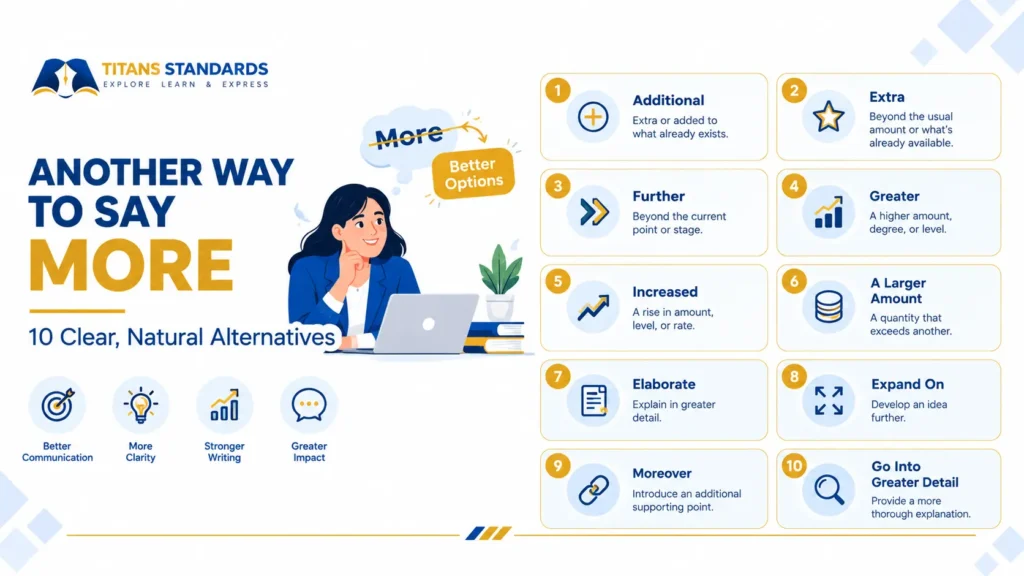
Another way to say more depends on the context. You can use additional, extra, further, greater, increased, or a larger amount when discussing quantity. For writing and conversations, phrases like elaborate, expand on, provide more details, and go into greater detail help you express your ideas clearly and naturally. Key Takeaways What Does “Another Way to Say More” Mean? The phrase “another way to say more” refers to alternative words or expressions that communicate the same or a similar meaning as more. The best replacement depends on whether you are talking about quantity, degree, additional information, or expanding an idea. For example, you might say “additional information” instead of “more information” in a professional email. In a conversation, “tell me a little more” could become “give me more details” or “elaborate a little.” People look for alternatives to “more” to avoid repetition, improve sentence flow, and communicate their ideas more precisely. These expressions are useful in emails, essays, business reports, everyday conversations, and academic writing. Why Use Other Ways to Say “More”? Although “more” is a common and useful word, repeating it too often can make writing sound vague or repetitive. Choosing a more precise expression helps readers understand exactly what you mean. Here are a few benefits of using alternatives: 10 Best Other Ways to Say “More” 1. Additional Meaning “Additional” means extra or added to something that already exists. It works especially well when discussing information, resources, documents, tasks, or items. This word is a strong choice for professional communication because it sounds clear and direct without being overly formal. Best For: Professional, Formal, Polite Example 1: Please attach any additional documents before submitting your application. Example 2: Our team may need additional time to complete the final review. Quick Tip: Use “additional” before a noun, such as “additional support,” “additional details,” or “additional resources.” 2. Extra Meaning “Extra” refers to something beyond the usual amount or what is already available. It is a natural alternative to “more” in everyday conversations, customer service, and informal workplace communication. It often sounds friendlier and more conversational than “additional.” Best For: Casual, Friendly, Professional Example 1: Could you bring an extra chair for our guest? Example 2: The hotel offers extra towels upon request. Quick Tip: Choose “extra” for everyday situations, but consider “additional” when writing a formal business proposal or official report. 3. Further Meaning “Further” refers to something beyond the current point, amount, or stage. It is particularly useful when discussing progress, investigation, explanation, or future action. In professional writing, it can make requests sound measured and polished. Best For: Professional, Formal, Polite Example 1: We will conduct further testing before releasing the software. Example 2: Please contact our office if you require further assistance. Quick Tip: Use “further information,” “further discussion,” or “further review” when referring to the next step in a process. 4. Greater Meaning “Greater” describes a higher amount, degree, level, or importance. Unlike “additional,” which often refers to something added, “greater” emphasizes the size or extent of something. It works well in business reports, academic writing, and discussions about performance or impact. Best For: Professional, Formal Example 1: The new training program gave employees greater confidence in their abilities. Example 2: We need greater transparency when reporting project expenses. Quick Tip: Use “greater” when comparing levels or degrees, such as “greater efficiency,” “greater influence,” or “greater responsibility.” 5. Increased Meaning “Increased” describes an amount, level, or rate that has risen. It is especially useful when discussing measurable changes, business performance, demand, costs, or activity. This alternative is more specific than “more” when the sentence describes growth or an upward change. Best For: Professional, Formal Example 1: The company reported increased demand for its online services. Example 2: Increased practice helped the students improve their reading skills. Quick Tip: Use “increased” when describing a rise in something, rather than simply referring to extra items that have been added. 6. A Larger Amount Meaning “A larger amount” describes a quantity that exceeds another amount. It is useful when comparing money, materials, time, or other quantities that can be measured. The expression is straightforward and helps make comparisons clearer. Best For: Professional, Casual, Formal Example 1: The renovation will require a larger amount of funding than we originally expected. Example 2: Please set aside a larger amount of time for the final presentation. Quick Tip: Use “a larger amount” for uncountable quantities, such as money or time. For countable items, “a greater number” may be more accurate. 7. Elaborate Meaning “Elaborate” means to explain an idea in greater detail. It is useful when you want someone to clarify a statement, share their reasoning, or provide a fuller explanation. The word is common in meetings, interviews, academic discussions, and professional emails. Best For: Professional, Formal, Polite Example 1: Could you elaborate on the reasons behind your recommendation? Example 2: During the interview, the candidate elaborated on her experience managing remote teams. Quick Tip: Use “elaborate on” when referring to a specific subject, idea, or statement. For a simple everyday conversation, “explain a little more” may sound more natural. 8. Expand On Meaning “Expand on” means to develop an idea further by adding explanations, examples, or supporting information. It is useful when a topic needs more discussion or when an initial explanation feels incomplete. The phrase works in both spoken and written English. Best For: Professional, Friendly, Casual Example 1: Please expand on your proposal’s expected benefits during tomorrow’s meeting. Example 2: The teacher asked Mia to expand on her answer with a real-world example. Quick Tip: Follow “expand on” with the topic you want to develop, such as “expand on your findings” or “expand on this point.” 9. Moreover Meaning “Moreover” introduces an additional point that supports or strengthens what you have already said. It is often used in formal writing, persuasive arguments, reports, and essays. Unlike “additional” or “extra,” it connects ideas rather than describing a larger quantity. Best For: Formal, Professional Example 1: The proposal reduces
Another Way to Say He Said: 10 Better Alternatives

Another way to say “he said” includes “he replied,” “he explained,” “he remarked,” “he stated,” and “he noted.” These alternatives help writers create natural dialogue, avoid repetition, and show how a character communicates. Choose the right expression based on the speaker’s meaning, tone, and the context of the conversation. Key Takeaways What Does “He Said” Mean? “He said” is a common expression used to report the words spoken by a male person. Writers use it in stories, conversations, essays, news reports, and everyday communication to show who is speaking. For example, “He said he would arrive early” tells readers what the person communicated without adding extra emotion or interpretation. The expression is neutral, clear, and easy to understand. However, using it repeatedly in a story or paragraph can make the writing feel monotonous. Choosing an appropriate alternative can make dialogue more engaging while preserving the speaker’s intended meaning. Why Use Other Ways to Say “He Said”? Although “he said” works in most situations, other expressions can provide useful context and improve the flow of your writing. Consider these benefits: Remember that “said” is not a weak word. It is often the best choice when the dialogue itself already communicates the speaker’s feelings. 10 Best Other Ways to Say “He Said” 1. He Replied Meaning “He replied” indicates that someone responded to a question, comment, or statement. It works well in conversations because it clearly connects one person’s words to another person’s contribution. Best For: Casual, Friendly, Professional, Polite Example 1: “I’ll send you the updated schedule tonight,” he replied. Example 2: “No, I haven’t spoken to Daniel yet,” he replied. Quick Tip: Use “he replied” when the sentence directly answers something another person said. 2. He Answered Meaning “He answered” emphasizes that a person provided a response, particularly to a question. It is a straightforward alternative that works in fiction, school assignments, interviews, and everyday writing. Best For: Casual, Professional, Formal Example 1: “The meeting starts at nine,” he answered. Example 2: “I chose the blue folder because it was easier to find,” he answered. Quick Tip: Choose “he answered” when someone responds to a direct question or provides requested information. 3. He Explained Meaning “He explained” suggests that the speaker clarified an idea, described a process, or provided reasons for something. This phrase helps readers understand that the character is offering more information rather than simply making a statement. Best For: Professional, Formal, Friendly Example 1: “The delay happened because the supplier shipped the wrong parts,” he explained. Example 2: “You need to save the document before closing the program,” he explained. Quick Tip: Use “he explained” when the dialogue makes a situation, reason, or instruction clearer. 4. He Stated Meaning “He stated” presents information directly and clearly. It often sounds more formal than “he said,” making it suitable for reports, official communications, academic writing, and situations where precise wording matters. Best For: Professional, Formal Example 1: “Our department will publish the final results on Friday,” he stated. Example 2: “The agreement remains valid until December 31,” he stated. Quick Tip: Reserve “he stated” for contexts where a formal or factual tone is appropriate. 5. He Remarked Meaning “He remarked” describes a comment or observation made during a conversation. It can make dialogue feel more varied and natural, particularly when a character shares an opinion or notices something interesting. Best For: Casual, Friendly, Formal Example 1: “The new library looks much brighter after the renovation,” he remarked. Example 2: “Everyone seems unusually quiet this morning,” he remarked. Quick Tip: Use “he remarked” for comments and observations rather than detailed explanations or direct answers. 6. He Noted Meaning “He noted” indicates that someone pointed out a fact, detail, or observation worth considering. It is especially useful when a character highlights information that supports a discussion or adds an important detail. Best For: Professional, Formal Example 1: “The latest report shows a steady increase in customer satisfaction,” he noted. Example 2: “We still have two outstanding items on the checklist,” he noted. Quick Tip: Choose “he noted” when the speaker draws attention to a specific fact or detail. 7. He Added Meaning “He added” introduces another point or piece of information after a previous statement. It helps writers show that a character is continuing an explanation or contributing something extra to the conversation. Best For: Casual, Friendly, Professional Example 1: “We should leave before sunset,” he added. Example 2: “The restaurant also offers a separate menu for children,” he added. Quick Tip: Use “he added” when the character contributes further information rather than starting an unrelated topic. 8. He Admitted Meaning “He admitted” suggests that someone acknowledged a fact, mistake, or truth that might be uncomfortable or difficult to accept. Unlike the neutral “he said,” this expression implies that the information involves some degree of acknowledgment or reluctance. Best For: Casual, Friendly, Formal Example 1: “I forgot to attach the file to the email,” he admitted. Example 2: “I was nervous about speaking in front of the entire class,” he admitted. Quick Tip: Use “he admitted” only when the speaker acknowledges something significant, such as a mistake or personal concern. 9. He Declared Meaning “He declared” presents a statement with emphasis, confidence, or a sense of determination. It can suit dramatic fiction, public announcements, and situations where a character makes a strong claim or expresses a firm intention. Best For: Formal, Professional, Dramatic Example 1: “I will finish this project before the deadline,” he declared. Example 2: “Our team is ready to compete for the championship,” he declared. Quick Tip: Use “he declared” when the statement feels emphatic. Avoid it for ordinary, low-key conversations. 10. He Observed Meaning “He observed” introduces a comment based on something the speaker notices or considers. It works well in descriptive storytelling and thoughtful discussions, especially when a character points out a detail that others may have overlooked. Best For: Formal, Professional Example 1: “The two proposals share several important features,” he observed. Example 2:
Another Way to Say So: 10 Better Alternatives for Any Situation
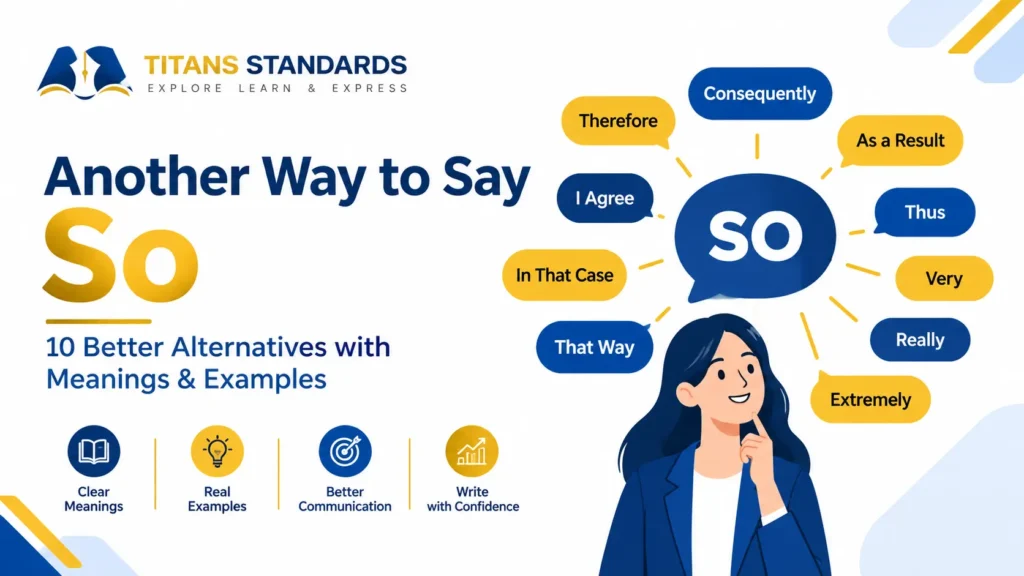
Another way to say “so” depends on the meaning and context. Use “therefore,” “consequently,” or “as a result” to show a conclusion. Choose “very,” “really,” or “extremely” to add emphasis. For agreement, phrases like “I agree” or “that’s right” may work better. The best alternative makes your sentence clear and natural. Key Takeaways What Does “So” Mean? The word “so” has several meanings in American English. It can show a result, add emphasis, express agreement, or describe a way of doing something. For example, “It was raining, so we stayed home” uses “so” to show a result. In “I’m so happy,” it adds emphasis. In “I think so,” it expresses agreement or a belief. Because “so” serves different purposes, no single synonym works in every sentence. Choosing the right alternative depends on what you want to communicate. Why Use Other Ways to Say “So”? Although “so” is common and natural, using it repeatedly can make your writing sound less precise. The right alternative can improve clarity and help you match your audience. Consider these benefits: 10 Best Alternatives to “So” 1. Therefore Meaning: “Therefore” introduces a conclusion based on information already presented. It is a useful alternative when “so” connects a reason with a result. Best For: Professional, Formal Example 1: The report contains several errors; therefore, we need to revise it before publication. Example 2: Sales declined this quarter; therefore, the team will review its marketing strategy. Quick Tip: Use “therefore” in reports, essays, and business documents when you want to make a logical connection. 2. Consequently Meaning: “Consequently” explains what happened because of a previous action or situation. It often sounds more formal than “so” and highlights the result of a decision or event. Best For: Professional, Formal Example 1: The supplier missed the deadline; consequently, production started two days late. Example 2: The company reduced operating costs, consequently improving its overall financial performance. Quick Tip: Choose “consequently” when the result follows clearly from the situation you described. 3. As a Result Meaning: “As a result” introduces an outcome caused by something mentioned earlier. It works well in everyday explanations, professional emails, and informative articles. Best For: Professional, Neutral Example 1: Maya practiced her presentation every day. As a result, she delivered it with confidence. Example 2: The road was closed for repairs. As a result, commuters had to take another route. Quick Tip: Use this phrase when you want to explain cause and effect without sounding overly formal. 4. Thus Meaning: “Thus” shows a conclusion or outcome. It is concise and often appears in academic writing, technical explanations, and formal discussions. Best For: Formal, Professional Example 1: The sample size was too small, thus limiting the study’s conclusions. Example 2: The team combined the two databases, thus creating a single source of customer information. Quick Tip: Use “thus” when a short, precise transition fits your writing. In casual conversation, “so” often sounds more natural. 5. Very Meaning: “Very” emphasizes the degree of an adjective or adverb. It can replace “so” when the word expresses intensity rather than a result. Best For: Neutral, Professional, Casual Example 1: The instructions were very clear, even for first-time users. Example 2: We are very pleased with the progress your team has made. Quick Tip: Compare “The room is so quiet” with “The room is very quiet.” Both express intensity, but “so” can carry more emotion or surprise. 6. Really Meaning: “Really” adds emphasis and can express sincerity, surprise, or a strong feeling. It is common in spoken American English and informal writing. Best For: Casual, Friendly, Warm Example 1: I really appreciate you staying late to help with the project. Example 2: That was a really thoughtful gift, and I’ll remember it for a long time. Quick Tip: Use “really” in friendly messages and natural conversations. In formal reports, a more precise description may be stronger. 7. Extremely Meaning: “Extremely” describes a very high degree of something. It often sounds stronger than “very” and is useful when you want to communicate intensity clearly. Best For: Professional, Formal, Neutral Example 1: The new software is extremely useful for organizing large amounts of data. Example 2: The hiking trail became extremely difficult after the rain. Quick Tip: Reserve “extremely” for situations where strong emphasis is justified. Overusing it can make your writing sound exaggerated. 8. That Way Meaning: “That way” describes a method or approach, often explaining how an action will help achieve a goal. It can replace “so” when the intended meaning is “by doing this.” Best For: Casual, Friendly, Professional Example 1: Save a copy of the file before editing it. That way, you can restore the original if needed. Example 2: Let’s send the agenda today. That way, everyone has time to prepare. Quick Tip: Use “that way” to explain the practical benefit of an action, especially when giving advice or instructions. 9. In That Case Meaning: “In that case” introduces a response or decision based on new information. It is useful when circumstances change or you need to adjust a plan. Best For: Polite, Professional, Casual Example 1: If your flight arrives after midnight, in that case, we can arrange a later pickup. Example 2: You already have a membership? In that case, you can access the course at no extra cost. Quick Tip: Use this phrase when reacting to a condition or new detail. Avoid adding it when the situation is already obvious. 10. I Agree Meaning: “I agree” communicates that you share someone’s opinion or support their point. It can replace “I think so” when you want to express agreement directly rather than uncertainty. Best For: Professional, Polite, Friendly Example 1: “Should we send the proposal before Friday?” “I agree; that gives the client enough time to review it.” Example 2: “The new schedule is easier to manage.” “I agree, especially with the shorter meetings.” Quick Tip: Use “I agree” when responding to an opinion or suggestion. If you are uncertain, phrases such as “I think
Another Way to Say Crucial: 10 Powerful Synonyms to Use

The word “crucial” helps you show that something matters a great deal. You might use it in a business email, a school assignment, a project update, or an everyday conversation. However, repeating the same word can make your writing feel less natural. Choosing another way to say crucial allows you to express importance more precisely. Some alternatives highlight necessity, while others emphasize urgency, influence, or value. Below are 10 useful options, with meanings, examples, and practical tips to help you choose the right phrase. Key Takeaways What Does “Another Way to Say Crucial” Mean? The phrase “another way to say crucial” refers to alternative words or expressions that communicate great importance. Common synonyms include essential, vital, critical, and significant. People search for these alternatives to improve their vocabulary, avoid repetition, and make their writing more effective. These words appear frequently in professional emails, academic papers, business reports, presentations, and everyday conversations. Although the alternatives share a similar meaning, they are not always interchangeable. For example, “critical” can suggest urgency, while “pivotal” highlights a turning point or a major influence on an outcome. Why Use Other Ways to Say Crucial? Using different words is crucial and helps you communicate clearly and match your language to the situation. The right alternative can make your message sound more natural, precise, and professional. Here are the main benefits: 10 Best Other Ways to Say Crucial 1. Essential Meaning: Essential describes something absolutely necessary or required for a particular purpose. It often suggests that a task, resource, or action cannot be left out without causing a problem. Best For: Professional, Formal, Polite Example 1: Clear communication is essential for keeping our remote team organized. Example 2: Regular practice is essential if you want to improve your writing skills. Quick Tip: Use “essential” when you want to emphasize necessity rather than urgency. 2. Vital Meaning: Vital means extremely important to the success, health, or proper functioning of something. It can carry more emotional weight than “important,” making it useful when the consequences really matter. Best For: Professional, Formal Example 1: Accurate data is vital to making informed business decisions. Example 2: Getting enough sleep is vital for maintaining good health. Quick Tip: Choose “vital” when the outcome depends heavily on a particular action, resource, or condition. 3. Critical Meaning: Critical describes something that has a major effect on an outcome or requires immediate attention. It is common in business, technology, healthcare, and situations involving deadlines or potential risks. Best For: Professional, Formal Example 1: Fixing the security issue is critical before the software launch. Example 2: The next two weeks will be critical to the project’s success. Quick Tip: Use “critical” when urgency, risk, or serious consequences are part of the message. 4. Important Meaning: Important is a broad, everyday alternative that communicates value or significance. It is less intense than “crucial” in many contexts, making it a good choice when you want to sound clear without overstating your point. Best For: Professional, Casual, Friendly Example 1: It’s important to confirm the meeting time with every participant. Example 2: Building trust is important in any long-term relationship. Quick Tip: Choose “important” for general statements when stronger language is unnecessary. 5. Significant Meaning: Significant refers to something that has considerable meaning, value, or influence. It works particularly well when describing measurable progress, meaningful changes, research findings, or developments that deserve attention. Best For: Professional, Formal Example 1: The updated training program led to a significant improvement in employee performance. Example 2: This policy change could have a significant effect on small businesses. Quick Tip: Use “significant” to highlight meaningful impact rather than an urgent need. 6. Indispensable Meaning: Indispensable describes someone or something that is so valuable or necessary that it is difficult to manage without it. The word emphasizes usefulness and the absence of a suitable replacement. Best For: Professional, Formal, Warm Example 1: Her experience has made her an indispensable member of our team. Example 2: Reliable customer feedback is indispensable when improving a new product. Quick Tip: Reserve “indispensable” for situations where something is truly difficult to replace or do without. 7. Key Meaning: Key means central to a goal, process, or result. It is a concise, natural alternative that fits professional communication without sounding overly formal. Best For: Professional, Casual, Friendly Example 1: Customer satisfaction is a key factor in our company’s growth. Example 2: Setting realistic goals is key to staying motivated throughout the semester. Quick Tip: Use “key” in phrases such as “key factor,” “key role,” and “key priority.” Remember that “key to” is followed by a noun or a gerund. 8. Imperative Meaning: Imperative means absolutely necessary or extremely important, often because a situation demands action. It sounds stronger and more formal than “important,” especially in instructions, policies, and official communications. Best For: Formal, Professional Example 1: It is imperative that all employees complete the security training by Friday. Example 2: Protecting customer information is imperative for maintaining public trust. Quick Tip: Use “imperative” when you need to communicate a firm requirement, not simply a preference. 9. Pivotal Meaning: Pivotal describes something that plays a central role in determining what happens next. It often refers to a decision, event, person, or moment that can change the direction of a situation. Best For: Professional, Formal Example 1: Her presentation played a pivotal role in securing the partnership. Example 2: The final interview was a pivotal moment in his career. Quick Tip: Choose “pivotal” when the focus is on influence, turning points, or changes in direction. 10. Consequential Meaning: Consequential describes something that produces important results or has lasting effects. Unlike “essential,” it does not necessarily mean something is required; instead, it emphasizes the seriousness or impact of what happens. Best For: Formal, Professional Example 1: The board made a consequential decision about the company’s future. Example 2: Small changes to the contract could have consequential effects on both parties. Quick Tip: Use “consequential” when discussing decisions, actions, or events with
Another Way to Say A Lot: 10 Better Alternatives

Sometimes, the phrase “a lot” feels too basic, especially when you want to write a professional email, improve an essay, or express an idea more clearly. Although it works well in everyday conversations, choosing a more specific expression can make your message sound more natural. The best alternative depends on what you mean. You might be describing a large quantity, a high number of people, strong feelings, or the extent of an action. In this guide, you’ll discover 10 useful alternatives to “a lot,” along with meanings, examples, and practical tips to help you choose the right expression. Key Takeaways What Does “A Lot” Mean? “A lot” means a large amount, a high number, or a considerable degree of something. People commonly use it in spoken English and informal writing to describe quantities, frequency, feelings, and actions. For example, “I learned a lot from the workshop” means you gained a great deal of knowledge. Similarly, “We have a lot of customers” means the business serves many customers. The phrase is versatile, but it can sound vague when used repeatedly. More precise alternatives help readers understand exactly what you mean. Why Use Other Ways to Say “A Lot”? Using different expressions can improve your vocabulary and make your writing more engaging. The right phrase also helps you communicate your meaning clearly in different situations. Consider these benefits: 10 Best Other Ways to Say “A Lot” 1. A Great Deal Meaning “A great deal” means a large amount or a considerable degree. It works especially well when discussing knowledge, effort, importance, or uncountable things. This expression sounds more polished than “a lot” and fits professional communication without feeling overly formal. Best For: Professional, Formal, Polite Example 1: We appreciate the great deal of effort you put into this project. Example 2: The training program taught me a great deal about customer service. Quick Tip: Use “a great deal of” before an uncountable noun, such as time, effort, or information. 2. Numerous Meaning “Numerous” means many or a large number of something. It is particularly useful when discussing people, opportunities, problems, examples, or other countable items. It gives writing a more formal tone and works well in academic assignments, business reports, and professional documents. Best For: Professional, Formal Example 1: Our team received numerous applications for the open position. Example 2: The report identifies numerous opportunities for improving customer satisfaction. Quick Tip: Use “numerous” with plural countable nouns, not uncountable nouns such as water or advice. 3. Plenty Meaning “Plenty” means more than enough or a sufficient amount. It often creates a reassuring, positive tone when discussing resources, time, opportunities, or available choices. The phrase “plenty of” is common in everyday American English and works in both casual and moderately professional situations. Best For: Casual, Friendly, Warm Example 1: We have plenty of time to review the proposal before Friday. Example 2: There are plenty of opportunities to develop your writing skills. Quick Tip: Use “plenty of” when you want to emphasize that something is available in a sufficient or generous amount. 4. A Large Amount Meaning “A large amount” describes a substantial quantity of something. It is useful when you want to sound clear and neutral without relying on informal language. This expression commonly appears in reports, explanations, research summaries, and discussions about money, time, energy, or other uncountable nouns. Best For: Professional, Formal Example 1: The company invested a large amount of money in employee training. Example 2: Preparing the presentation required a large amount of research. Quick Tip: Use “a large amount of” with uncountable nouns. For countable items, “a large number of” is usually more appropriate. 5. Tons Meaning “Tons” is an informal expression that means a very large amount or number. It is common in American conversations, text messages, and friendly online communication. Although it can make your language sound relaxed and enthusiastic, it is generally unsuitable for formal reports or highly professional correspondence. Best For: Casual, Friendly Example 1: Thanks for sharing tons of helpful advice before my interview. Example 2: We took tons of photos during our weekend trip. Quick Tip: Reserve “tons of” for relaxed settings where conversational language feels natural. 6. Countless Meaning “Countless” describes something so numerous that it is difficult to count. It can also add emphasis when discussing repeated experiences, possibilities, or memorable moments. This expression is more vivid than “a lot” and often works well in storytelling, essays, and persuasive writing. Best For: Formal, Friendly Example 1: She has helped countless students prepare for their college applications. Example 2: Countless hours of practice helped the team improve its performance. Quick Tip: Use “countless” when you want to emphasize an exceptionally high number rather than an ordinary quantity. 7. Extensively Meaning “Extensively” means thoroughly, widely, or to a considerable extent. Unlike “a lot,” which often describes quantity, this adverb usually explains how thoroughly an action was performed. It is particularly useful in professional, academic, and technical writing. Best For: Professional, Formal Example 1: The research team extensively reviewed the available evidence. Example 2: We tested the software extensively before releasing the update. Quick Tip: Use “extensively” to describe actions such as researching, reviewing, testing, or studying. It is not a direct replacement for every use of “a lot.” 8. Significantly Meaning “Significantly” means noticeably, considerably, or to an important degree. It works well when describing measurable changes, meaningful differences, or substantial improvements. The word is especially useful in reports, presentations, research, and business communication. Best For: Professional, Formal Example 1: Customer satisfaction improved significantly after the support team introduced live chat. Example 2: The new scheduling system significantly reduced waiting times. Quick Tip: Use “significantly” when describing an important change or effect. Do not use it merely to indicate a large number of objects. 9. Many Meaning “Many” means a large number of people, things, or events. It is one of the simplest and most natural alternatives to “a lot” when referring to countable nouns. Because it is widely understood
Another Way to Say Happy Tuesday: 10 Cheerful Alternatives

Tuesday is a great opportunity to send someone a positive message, whether you’re greeting a coworker, texting a friend, or sharing an uplifting post online. However, using “Happy Tuesday” every week can start to feel repetitive. Fortunately, there are plenty of natural ways to express the same cheerful feeling. You can choose a short greeting, a thoughtful wish, or a motivating message depending on the person and situation. In this guide, you’ll discover 10 alternatives to “Happy Tuesday,” with meanings, examples, and practical tips to help you choose the right expression. What Does “Another Way to Say Happy Tuesday” Mean? The phrase “another way to say Happy Tuesday” refers to alternative expressions that communicate happiness, encouragement, or good wishes on a Tuesday. People commonly use these greetings in text messages, emails, social media captions, team chats, and conversations with friends or family. The goal is to acknowledge the day while sharing a little positivity. For example, “Have a terrific Tuesday” sounds cheerful, while “Wishing you a productive Tuesday” suits a workplace message. Both express goodwill but create slightly different impressions. Why Use Other Ways to Say “Happy Tuesday”? Choosing different Tuesday greetings helps you communicate naturally and make your messages more personal. Here are the main benefits: 10 Best Other Ways to Say “Happy Tuesday” 1. Have a Terrific Tuesday Meaning: This cheerful expression wishes someone an enjoyable and successful day. The repeated T sound makes it catchy and memorable. Best For: Friendly, Casual, Warm Example 1: Have a terrific Tuesday, everyone! Let’s make today’s team meeting a great one. Example 2: I hope you have a terrific Tuesday and find time to do something you love. Quick Tip: Use this phrase in morning texts, group chats, and upbeat social media captions. 2. Wishing You a Wonderful Tuesday Meaning: This phrase expresses a thoughtful wish for someone to enjoy their day. It feels slightly more polished than a casual greeting without sounding stiff. Best For: Polite, Formal, Warm Example 1: Wishing you a wonderful Tuesday filled with good news and happy moments. Example 2: Wishing you a wonderful Tuesday as you prepare for your upcoming vacation. Quick Tip: Choose this expression for greeting cards, client messages, or notes to people you respect. 3. Hope Your Tuesday Is Off to a Great Start Meaning: This greeting focuses on how someone’s day is beginning. It sounds conversational and shows interest in the person’s morning rather than simply naming the day. Best For: Friendly, Professional, Warm Example 1: Good morning, Sarah! Hope your Tuesday is off to a great start. Example 2: Hope your Tuesday is off to a great start and your new project is going smoothly. Quick Tip: This is an excellent opening for a friendly work email or a morning text. 4. Have a Fantastic Tuesday Meaning: This expression communicates strong enthusiasm and a desire for someone to enjoy the day. “Fantastic” adds extra energy to an otherwise simple greeting. Best For: Casual, Friendly, Warm Example 1: Have a fantastic Tuesday, and enjoy your first day at the new office! Example 2: Thanks for all your help yesterday. Have a fantastic Tuesday! Quick Tip: Use it when you want to sound upbeat without writing a long message. 5. Wishing You a Productive Tuesday Meaning: This greeting emphasizes progress, focus, and accomplishment. It works particularly well when someone has work to complete, meetings to attend, or goals to reach. Best For: Professional, Polite, Formal Example 1: Wishing you a productive Tuesday as we finalize the quarterly report. Example 2: I hope your team has a productive Tuesday and makes good progress on the launch. Quick Tip: Pair this phrase with a brief, relevant work update when emailing colleagues or business partners. 6. Hope You Have a Great Day Meaning: This versatile expression wishes someone a pleasant day without mentioning Tuesday directly. Its simplicity makes it suitable for almost any everyday interaction. Best For: Casual, Professional, Friendly Example 1: Thanks for stopping by this morning. Hope you have a great day! Example 2: I’ll send you the revised document before lunch. Hope you have a great day. Quick Tip: Use this alternative when you want a natural greeting that works on any day of the week. 7. Sending You Some Tuesday Cheer Meaning: This expression shares a little happiness and encouragement with someone. It feels personal, lighthearted, and supportive, especially when the recipient could use a mood boost. Best For: Friendly, Warm, Casual Example 1: Sending you some Tuesday cheer and hoping your interview goes really well! Example 2: Here’s a little reminder that you’re doing great. Sending you some Tuesday cheer! Quick Tip: Save this phrase for friends, family members, or coworkers you know well enough to message warmly. 8. Make the Most of Your Tuesday Meaning: This phrase encourages someone to use the day positively. Instead of simply wishing them happiness, it suggests taking opportunities, making progress, or enjoying meaningful moments. Best For: Motivational, Friendly, Professional Example 1: Make the most of your Tuesday and take that first step toward your goal. Example 2: You’ve prepared all week for this presentation, so make the most of your Tuesday! Quick Tip: Choose this expression when you want to inspire action rather than offer a standard greeting. 9. Here’s to a Beautiful Tuesday Meaning: This warm expression celebrates the possibility of a pleasant day. It sounds thoughtful and slightly poetic, making it suitable for uplifting messages and social media posts. Best For: Warm, Friendly, Casual Example 1: Here’s to a beautiful Tuesday filled with sunshine, laughter, and fresh opportunities. Example 2: Here’s to a beautiful Tuesday and a peaceful evening with the people you love. Quick Tip: Pair this greeting with a nature photo or a positive morning caption. 10. May Your Tuesday Be Filled With Good Things Meaning: This expression offers a sincere wish for happiness, pleasant surprises, and positive experiences. It feels more personal than a short greeting because it expresses hope for the recipient’s entire day. Best For:
Another Way to Say Customer: 10 Best Alternatives

The word “customer” appears frequently in business emails, marketing materials, sales reports, and everyday conversations. Although it is clear and widely understood, using the same word repeatedly can make your writing feel predictable. Choosing another way to say customer helps you communicate more naturally and accurately. Whether you are writing a professional email, describing a target audience, or improving website content, the right alternative can make your message clearer. In this guide, you will discover 10 alternatives to “customer,” including their meanings, practical examples, and tips for choosing the right word. Another way to say customer includes client, consumer, buyer, purchaser, patron, shopper, user, guest, account, and clientele. The best alternative depends on the context. Use “client” for professional services, “consumer” for market research, “buyer” for sales, and “patron” for people who support businesses such as restaurants, theaters, or libraries. Key Takeaways What Does “Another Way to Say Customer” Mean? Another way to say customer refers to a different word or phrase that describes someone who buys, uses, or receives products and services from a business. Common alternatives include “client,” “consumer,” “buyer,” and “patron.” However, these words are not always interchangeable. A client may receive professional advice, while a consumer is often discussed in relation to products, markets, and buying behavior. People use these alternatives to avoid repetition, match different professional settings, and communicate more precisely. Why Use Other Ways to Say Customer? Using different words for “customer” can improve your writing and help you describe business relationships more accurately. Consider these benefits: The key is to choose a word that fits the situation rather than replacing “customer” simply for variety. 10 Best Other Ways to Say “Customer” 1. Client Meaning A client is someone who receives professional services, advice, or ongoing support from a person or business. The word often suggests an established relationship rather than a single purchase. Best For: Professional, Formal, Polite Example 1: Our agency helps each client develop a marketing strategy that fits their goals. Example 2: The attorney scheduled a meeting with her client to review the contract. Quick Tip: Use “client” for consultants, lawyers, accountants, designers, and other service professionals. 2. Consumer Meaning A consumer is someone who uses goods or services. The term often appears in discussions about markets, spending habits, product demand, and consumer behavior. Best For: Professional, Formal Example 1: Consumers increasingly compare product reviews before making a purchase. Example 2: The company surveyed 500 consumers to understand their shopping preferences. Quick Tip: Choose “consumer” for market research, business reports, and discussions about purchasing trends. 3. Buyer Meaning A buyer is someone who purchases or intends to purchase a product or service. This term emphasizes the buying decision and works well in sales, retail, and business transactions. Best For: Professional, Casual Example 1: The sales team offered first-time buyers a discount on selected products. Example 2: Buyers can compare different plans before choosing a subscription. Quick Tip: Use “buyer” when discussing purchasing decisions, sales leads, or people considering a purchase. 4. Purchaser Meaning A purchaser is a person or organization that buys something. It sounds slightly more formal than “buyer” and often appears in contracts, procurement documents, property transactions, and official business communication. Best For: Professional, Formal Example 1: The purchaser must complete the payment before the equipment ships. Example 2: Each property purchaser receives a copy of the signed agreement. Quick Tip: Choose “purchaser” for formal transactions and documents where precision matters. 5. Patron Meaning A patron is someone who regularly visits or supports an establishment, service, or organization. The word is particularly common in restaurants, theaters, libraries, museums, and arts organizations. Best For: Formal, Friendly, Warm Example 1: The restaurant thanked its patrons for supporting the new menu. Example 2: Library patrons can reserve books through the online catalog. Quick Tip: Use “patron” when you want to emphasize support for an establishment rather than a specific purchase. 6. Shopper Meaning A shopper is someone who looks for or buys products, especially in retail stores or online shops. The term can describe people who are browsing as well as those who are ready to purchase. Best For: Casual, Friendly, Professional Example 1: Online shoppers can filter products by price, size, and customer rating. Example 2: The store offers free gift wrapping to holiday shoppers. Quick Tip: Use “shopper” in retail marketing, e-commerce content, and discussions about shopping habits. 7. User Meaning A user is someone who uses a product, platform, application, or service. Unlike “buyer,” this term does not necessarily mean the person paid for it. Best For: Professional, Casual Example 1: The software update makes it easier for users to organize their files. Example 2: New users can create an account in less than two minutes. Quick Tip: Choose “user” for technology products, digital platforms, mobile apps, and subscription services. 8. Guest Meaning A guest is someone welcomed into a place or provided with hospitality. Hotels, resorts, restaurants, and event venues commonly use this term to create a welcoming and personal experience. Best For: Friendly, Warm, Polite Example 1: Every hotel guest receives complimentary breakfast during their stay. Example 2: Our team welcomes each guest with a personalized check-in experience. Quick Tip: Use “guest” in hospitality settings when emphasizing comfort, service, and a positive experience. 9. Account Meaning In business, “account” can refer to a customer relationship or the business record associated with it. Companies often use this term when discussing ongoing sales relationships, billing, or account management. Best For: Professional, Formal Example 1: Our account manager will contact you about the renewal next week. Example 2: The sales representative reviewed the account before preparing the proposal. Quick Tip: Use “account” when discussing business relationships or records, not as a universal replacement for an individual customer. 10. Clientele Meaning Clientele refers to the group of customers or clients served by a business or professional. Unlike the other alternatives on this list, it is a collective noun rather than a word for one individual. Best For: Professional, Formal
Another Way to Say Work Together

Finding another way to say work together can help you communicate more clearly, avoid repetition, and sound more natural in English. Whether you’re writing a business email, preparing a team presentation, or talking about a shared project, the right phrase can make your message more effective. Although “work together” fits many situations, other expressions can highlight teamwork, cooperation, shared responsibility, or a common goal. Here are 10 useful alternatives, along with their meanings, examples, and tips for using them correctly. What Does “Another Way to Say Work Together” Mean? The phrase “another way to say work together” refers to alternative words or expressions that communicate the idea of people combining their efforts to complete a task or reach a shared goal. People commonly use these expressions in workplaces, schools, community projects, business partnerships, and everyday conversations. For example, you might say that two departments collaborate on a project or that friends team up to organize an event. Each alternative has a slightly different meaning. Some sound professional, while others feel casual, formal, or especially encouraging. Why Use Other Ways to Say “Work Together”? Using different expressions helps you match your language to the situation and explain teamwork more precisely. Here are some benefits: 10 Best Other Ways to Say “Work Together” 1. Collaborate Meaning “Collaborate” means working with one or more people to create something, solve a problem, or achieve a shared objective. It is one of the most useful alternatives to “work together” in professional and academic settings. Best For: Professional, Formal Example 1: Our marketing and design teams will collaborate on the new product launch. Example 2: The researchers collaborated to develop a more effective testing method. Quick Tip: Use “collaborate on” when naming a project or task, such as collaborating on a report or presentation. 2. Team Up Meaning “Team up” means joining another person or group to accomplish something. It sounds friendly and energetic, making it a natural choice for casual conversations, workplace discussions, and shared activities. Best For: Casual, Friendly, Professional Example 1: Let’s team up to prepare the conference presentation before Friday. Example 2: Three local businesses teamed up to organize a neighborhood food drive. Quick Tip: Use “team up with” to identify your partner, as in “I teamed up with my coworker.” 3. Cooperate Meaning “Cooperate” means helping others and making an effort to achieve a common goal. Unlike “collaborate,” which often suggests creating or developing something together, “cooperate” can emphasize willingness, coordination, and following shared plans. Best For: Professional, Formal, Polite Example 1: Both departments must cooperate to complete the audit on schedule. Example 2: The event organizers cooperated with city officials to manage traffic. Quick Tip: Choose “cooperate” when emphasizing helpful behavior or coordination rather than joint creative work. 4. Join Forces Meaning “Join forces” means combining the efforts, skills, or resources of two or more people or groups. It often suggests a purposeful partnership in which everyone contributes toward an important objective. Best For: Professional, Friendly, Formal Example 1: Two nonprofit organizations joined forces to provide meals for families in need. Example 2: Our sales and customer service teams will join forces to improve client support. Quick Tip: Use this phrase when you want to emphasize the strength that comes from combining resources or expertise. 5. Work in Partnership Meaning “Work in partnership” describes a cooperative relationship in which people or organizations contribute toward a shared objective. It sounds more formal than “team up” and can suggest an ongoing relationship with shared responsibilities. Best For: Professional, Formal, Polite Example 1: Our company works in partnership with local schools to support career training. Example 2: The two agencies will work in partnership to expand access to public services. Quick Tip: Choose this phrase for business proposals, official statements, and discussions about long-term relationships. 6. Coordinate Efforts Meaning “Coordinate efforts” means organizing different people’s activities so their work fits together effectively. This expression is especially useful when several teams have separate responsibilities but need to stay aligned. Best For: Professional, Formal Example 1: The project managers coordinated their efforts to meet the revised deadline. Example 2: We need to coordinate our efforts before the new store opens. Quick Tip: Use this phrase when planning, timing, communication, and organization matter as much as the work itself. 7. Join Hands Meaning “Join hands” means coming together to support a cause or achieve something collectively. It often carries a warm, community-focused, or inspirational tone, although it can sound less direct than other expressions in everyday American business writing. Best For: Friendly, Warm, Formal Example 1: Neighbors joined hands to rebuild the community garden after the storm. Example 2: Local volunteers joined hands to collect school supplies for children. Quick Tip: This expression works best for community initiatives, charitable causes, and messages about shared commitment. 8. Pool Resources Meaning “Pool resources” means combining available money, knowledge, equipment, time, or other assets to accomplish a goal. It focuses on what people contribute rather than simply stating that they work together. Best For: Professional, Formal Example 1: The two departments pooled their resources to purchase new software. Example 2: Several small businesses pooled their marketing budgets for a regional campaign. Quick Tip: Use this phrase when people are sharing practical resources, not just discussing ideas or dividing tasks. 9. Partner Up Meaning “Partner up” means joining another person or group to complete a task or participate in an activity. It is a straightforward, approachable expression that works well in classrooms, workplaces, and informal group settings. Best For: Casual, Friendly, Professional Example 1: Please partner up with a colleague to review the training materials. Example 2: The two developers partnered up to build a scheduling app. Quick Tip: Use “partner up with” when you want to make it clear who will be working alongside whom. 10. Collaborate Closely Meaning “Collaborate closely” means working with frequent communication, active involvement, and a strong focus on shared progress. It emphasizes the quality and consistency of the working relationship rather than simply
Another Way to Say Future: 10 Best Alternatives

Another way to say future includes “what lies ahead,” “the time ahead,” “the years to come,” “days to come,” and “what’s next.” For professional writing, use “long-term outlook” or “future prospects.” For casual conversations, “what’s next” sounds natural. The best alternative depends on your sentence, audience, and intended meaning. Key Takeaways What Does “Another Way to Say Future” Mean? The phrase “another way to say future” refers to alternative words or expressions that communicate the time ahead, upcoming events, or possibilities that have not happened yet. People search for these alternatives to improve their writing, avoid repeating the same word, and express ideas more clearly. Common examples include “what lies ahead,” “the years to come,” and “future prospects.” You can use these expressions in professional emails, school assignments, business reports, personal conversations, and creative writing. However, each phrase has a slightly different meaning and tone. Why Use Other Ways to Say “Future”? Using alternative expressions can make your writing more precise and engaging. Instead of repeating “future” several times, you can select a phrase that better reflects your intended meaning. Here are five reasons to explore other ways to say future: 10 Best Other Ways to Say “Future” 1. What Lies Ahead Meaning “What lies ahead” describes events, experiences, or possibilities that may happen in the future. It often suggests uncertainty because no one knows exactly how things will develop. Best For Example 1 We are excited to see what lies ahead for our growing business. Example 2 Although the next chapter may bring challenges, I feel hopeful about what lies ahead. Quick Tip Use this expression when discussing possibilities or upcoming experiences rather than a specific date or deadline. 2. The Years to Come Meaning “The years to come” refers to the years that follow the present. It is especially useful when discussing long-term goals, relationships, career plans, or lasting changes. Best For Example 1 Our new training program will help employees build valuable skills in the years to come. Example 2 We hope our partnership continues to grow in the years to come. Quick Tip Choose this phrase when discussing long-term expectations, not events that will happen in the next few hours or days. 3. Future Prospects Meaning “Future prospects” refers to the opportunities or potential outcomes that someone or something may have. This expression commonly appears in discussions about careers, education, business growth, and professional development. Best For Example 1 The internship could improve her future prospects in digital marketing. Example 2 The company is investing in new technology to strengthen its future prospects. Quick Tip Use “future prospects” when discussing opportunities or potential success. It is not a direct replacement for “future” in every sentence. 4. What’s Next Meaning “What’s next” is a conversational expression used to ask about or discuss the next event, step, or development. It focuses on what will happen after the current situation. Best For Example 1 Now that we have finished the first assignment, what’s next on our list? Example 2 I’m curious to see what’s next for the team after this major announcement. Quick Tip Use this phrase in everyday conversations, meetings, and informal updates. In formal reports, “next steps” may be more appropriate. 5. The Time Ahead Meaning “The time ahead” describes the period that begins now and continues into the future. It works well when discussing plans, expectations, or changes that may develop over time. Best For Example 1 We will review our progress regularly during the time ahead. Example 2 The time ahead will require patience, careful planning, and teamwork. Quick Tip Use this expression when emphasizing a period of time rather than one particular event. 6. Days to Come Meaning “Days to come” refers to an upcoming period, often the near future. Depending on the context, it can describe the next few days or a broader period of expected change. Best For Example 1 We expect to receive the final results in the days to come. Example 2 I hope the days to come bring you good news and new opportunities. Quick Tip This phrase often sounds reassuring or conversational. If a deadline matters, include the exact date instead. 7. The Upcoming Period Meaning “The upcoming period” describes a stretch of time that will begin soon or is approaching. It is useful in business communication when discussing schedules, planned activities, or expected changes. Best For Example 1 During the upcoming period, our department will focus on improving customer service. Example 2 We expect demand to increase during the upcoming period. Quick Tip This expression works best when readers understand which period you mean. Add dates or a time frame when greater precision is needed. 8. Tomorrow Meaning “Tomorrow” literally means the day after today. It can also represent the future more broadly, especially in motivational writing, speeches, and conversations about new opportunities. Best For Example 1 Let’s make thoughtful choices today that will benefit us tomorrow. Example 2 She believes tomorrow will bring better opportunities for her family. Quick Tip Use “tomorrow” literally when referring to the next day. When using it symbolically, make sure the broader meaning is clear. 9. The Long-Term Outlook Meaning “The long-term outlook” describes expectations about how a situation may develop over an extended period. It commonly appears in business, finance, career planning, and strategic discussions. Best For Example 1 The long-term outlook for the industry remains positive despite recent challenges. Example 2 Before expanding overseas, the company evaluated the long-term outlook for its products. Quick Tip Choose this phrase when discussing trends, forecasts, or expected outcomes over time. It is more specific than the general word “future.” 10. The Years Ahead Meaning “The years ahead” refers to the period that will follow the present, often emphasizing long-term experiences, challenges, or opportunities. Depending on the sentence, it can sound optimistic, reflective, or neutral. Best For Example 1 The skills you learn in college will support you throughout the years ahead. Example 2 The community is preparing for the changes expected